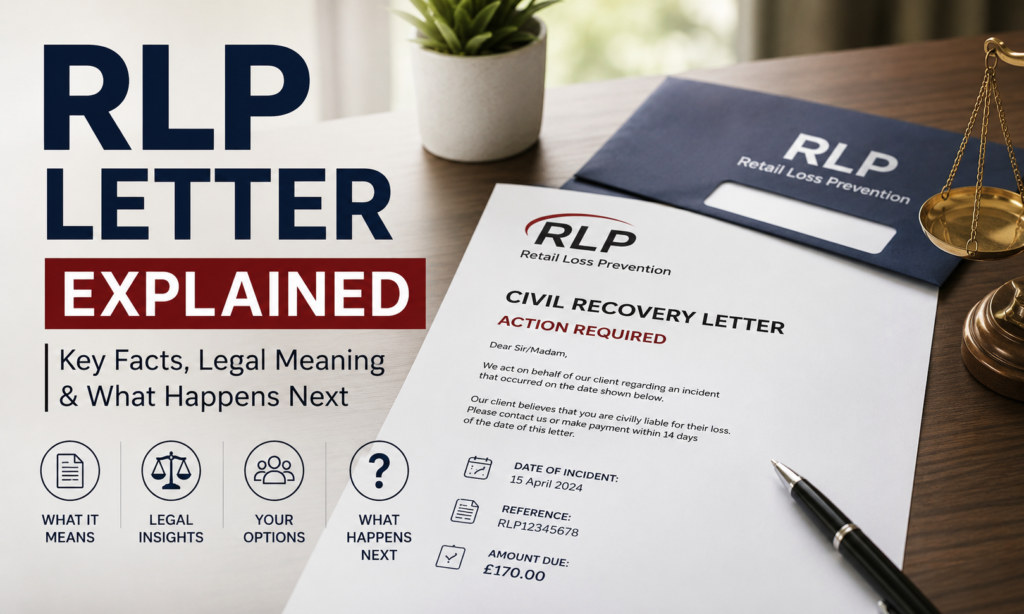

Receiving a letter demanding payment after an alleged incident in a shop can be confusing, particularly when the document uses legal terminology or mentions possible further action. In the United Kingdom, one term that frequently appears in this context is “RLP letter,” referring to correspondence associated with Retail Loss Prevention Limited. The letter generally relates to a civil recovery claim rather than a criminal conviction or court judgment.
Understanding what this correspondence means requires separating several overlapping processes: retail security, civil claims, police action, and court proceedings.
What Is an RLP Letter?
In the UK retail context, RLP stands for Retail Loss Prevention. Retail Loss Prevention Limited describes itself as a provider of civil recovery services for businesses and says it has operated in this area since 1998. The company works with businesses seeking compensation for alleged losses arising from incidents such as theft, fraud, damage, and other forms of wrongdoing.
An RLP letter is therefore generally correspondence about a retailer’s civil claim.
The distinction between a claim and a criminal penalty is important. A letter from RLP is not, simply because it has been received, a court judgment. It is correspondence connected with a claim that a business says it has against an individual.
RLP’s own explanation says its first letter normally identifies the date and location of the alleged incident, the business involved, how the claimed civil liability arose, the amount being claimed and the options available to the recipient.
That information is intended to allow the recipient to understand and respond to the claim.
Why Are RLP Letters Sent?
Retailers face financial losses from a range of incidents. Civil recovery developed as a mechanism for businesses to try to recover losses and associated costs.
According to RLP, its work can involve cases relating to:
- Alleged shoplifting
- Refund or discount fraud
- Price swapping
- Collusion
- Malicious damage
- Robbery
- Employee-related losses
- Other forms of alleged wrongdoing
The company says it acts as an agent for its business clients, not as the owner of the underlying claim.
The basic process is relatively straightforward. A retailer reports an incident and supplies information about the circumstances. RLP says it checks the information before sending correspondence to the person concerned.
The resulting letter may ask for payment as compensation for the business’s alleged loss.
Civil Recovery Is Different From Criminal Proceedings
One of the most important points for anyone trying to understand an RLP letter is the difference between civil recovery and criminal proceedings.
A criminal case concerns an alleged offense under criminal law and may involve police investigation and prosecution. A civil claim, by contrast, concerns an alleged legal liability between parties and can seek financial compensation.
RLP explicitly states that police involvement does not determine whether a civil claim can be pursued. Its customer information explains that police may or may not have been involved in the underlying incident.
This means several different situations can potentially arise:
- Police may investigate an alleged incident.
- Criminal proceedings may or may not follow.
- A retailer may separately pursue a civil claim.
- The parties may resolve the civil matter without court proceedings.
- If a dispute remains unresolved, civil court proceedings may become relevant.
These stages should not be treated as interchangeable.
An RLP letter itself does not establish that a court has ruled against the recipient.
The Historical Debate Around Civil Recovery
Civil recovery is not new to British retail. RLP says it pioneered civil recovery in the UK in 1998 and later developed programs across parts of the British Isles and Ireland.
The system has nevertheless been controversial for many years.
A significant public debate took place around 2009–2011, when Citizens Advice raised concerns about demands sent to people accused of low-value shoplifting or employee theft. The organization argued that some fixed-sum demands went beyond straightforward recovery of the value of goods and questioned the legal basis and proportionality of additional amounts.
The issue reached Parliament in 2011. During a Westminster Hall debate, the government acknowledged that retailers had a legal right to recover the value of goods lost or destroyed through wrongdoing. At the same time, ministers said there was no clear statutory basis for determining the additional costs recoverable in individual low-level theft cases, leaving courts to decide recoverable costs based on the facts of each case.
That historical debate remains relevant because it illustrates why an RLP demand should not automatically be confused with a government-imposed fine.
What Information Does an RLP Letter Usually Contain?
Although individual correspondence can differ, RLP says its first letter normally explains several essential details.
The alleged incident
The correspondence should identify when and where the incident allegedly occurred and which business was involved.
The basis of the claim
The letter explains why the retailer says civil liability arose.
The amount claimed
A monetary figure is normally included, along with information about how the recipient can address the claim.
Options for responding
RLP says its correspondence provides options for dealing with the matter and may include additional explanatory information.
For a recipient, these details matter more than the mere presence of the words “legal action.” Read the document in full to determine what stage the matter has reached.
What Happens If the Allegation Is Disputed?
An important feature of civil recovery is that a recipient can dispute the underlying allegation.
RLP says that when someone denies wrongdoing, they should provide details explaining what happened and why they believe there was no theft or fraud. The company states that it can then investigate such representations.
This is different from simply ignoring the correspondence.
A dispute may involve factual questions such as:
- Whether the alleged incident occurred
- What happened inside the store
- Whether merchandise was actually taken
- Whether a mistake or misunderstanding occurred
- Whether the person identified in the letter was correctly identified
- Whether the circumstances support the amount claimed
The precise legal position depends on the facts of the individual case.
Why the Amount Can Be Confusing
The value of the merchandise mentioned in an incident and the amount requested in a civil recovery claim are not necessarily identical.
Historically, this has been one of the most contested aspects of the system.
Citizens Advice argued during the earlier public debate that some demands included substantial additional sums for administration, security and related costs. Parliament subsequently discussed whether such additional amounts had a sufficiently clear legal basis.
The key point is that a figure appearing on a demand letter should not automatically be treated as equivalent to a criminal fine or a sum already awarded by a court.
If a dispute ultimately reaches court, the court can determine liability and recoverable losses based on the evidence and applicable law.
What If Someone Cannot Pay Immediately?
RLP’s current customer information states that payment arrangements may sometimes be available.
Its payment guidance says that individuals who cannot settle a claim in one payment may be able to arrange installments or a future settlement date, subject to its procedures.
Its general guidance also says recipients who need additional time for a valid reason can contact the company and request an agreed period.
This does not mean every case will have the same outcome. Individual circumstances, the nature of the claim and the correspondence already received can affect what options are available.
The Importance of Legal Advice
Because civil claims can have different factual and procedural circumstances, general internet information cannot determine a particular recipient’s legal position.
RLP itself advises people to seek advice from a solicitor or suitably qualified adviser if they do not understand the claim or are uncertain about their position. It also points recipients toward organizations such as Citizens Advice and other sources of legal assistance.
That advice is particularly relevant where the recipient disputes the allegation, is unsure about the amount claimed, has received formal court documents, or is dealing with a complicated personal situation.
A Letter Is Not the Same as a Court Judgment
This distinction deserves emphasis because legal correspondence can easily become confusing.
There are several different stages:
Stage General meaning
RLP correspondence Civil recovery communication concerning a retailer’s claim
Pre-action communication Correspondence intended to address a potential civil dispute before proceedings
Court claim Formal civil proceedings initiated through the court system
Judgment A court’s decision in the proceedings
These stages have different legal significance.
An RLP letter should therefore not automatically be described as a conviction, criminal fine or County Court Judgment. The actual document and its wording determine what stage a particular matter has reached.
Why the Issue Continues to Attract Attention
The continuing interest in RLP letters reflects a broader tension in retail crime policy.
Retailers have a financial interest in reducing theft and recovering losses. RLP argues that civil recovery gives businesses a mechanism to pursue compensation and address wrongdoing without relying exclusively on criminal proceedings.
Consumer advocates, meanwhile, have historically raised questions about proportionality, evidence and the amounts demanded in some cases. Citizens Advice’s earlier campaign illustrates the depth of that concern.
The disagreement is therefore not simply about whether retail crime creates costs. There has been broader debate over how those costs should be recovered, what evidence should support a claim, and how individuals should be treated when allegations are disputed.
What Could Happen Next?
For someone who receives an RLP letter, the next stage depends largely on the circumstances.
Possible developments can include:
- The recipient accepts the claim and settles.
- The recipient disputes the allegation and explains.
- The parties negotiate payment or another settlement arrangement.
- Additional correspondence follows.
- The matter is ultimately considered through civil court proceedings.
RLP describes pre-action correspondence as an opportunity for the parties to engage and resolve the matter before court action. It says court proceedings should be a last resort and that failure to engage can have consequences if litigation eventually follows.
The long-term legal significance therefore depends on what happens after the initial letter, not on the letter alone.
The Broader Significance of an RLP Letter
The phrase “RLP letter” may appear simple, but it sits at the intersection of retail security, civil law and consumer rights.
For retailers, civil recovery is one way to address losses linked to alleged wrongdoing. For recipients, however, a formal demand can raise immediate questions about liability, payment, evidence and possible legal consequences.
The history of civil recovery in the UK also shows why the subject has attracted both institutional support and criticism. Retailers and recovery companies have defended the process as a way to address losses, while consumer organizations have questioned how some demands have historically been calculated and pursued.
Ultimately, the meaning of an RLP letter depends on the specific document, the circumstances behind it and the legal stage reached. The most important distinction is between an allegation or civil demand and an actual court decision.
As retail crime, loss prevention and consumer protection continue to evolve, the wider question remains how businesses can recover legitimate losses while ensuring that civil claims are supported by appropriate evidence and handled fairly and proportionately.