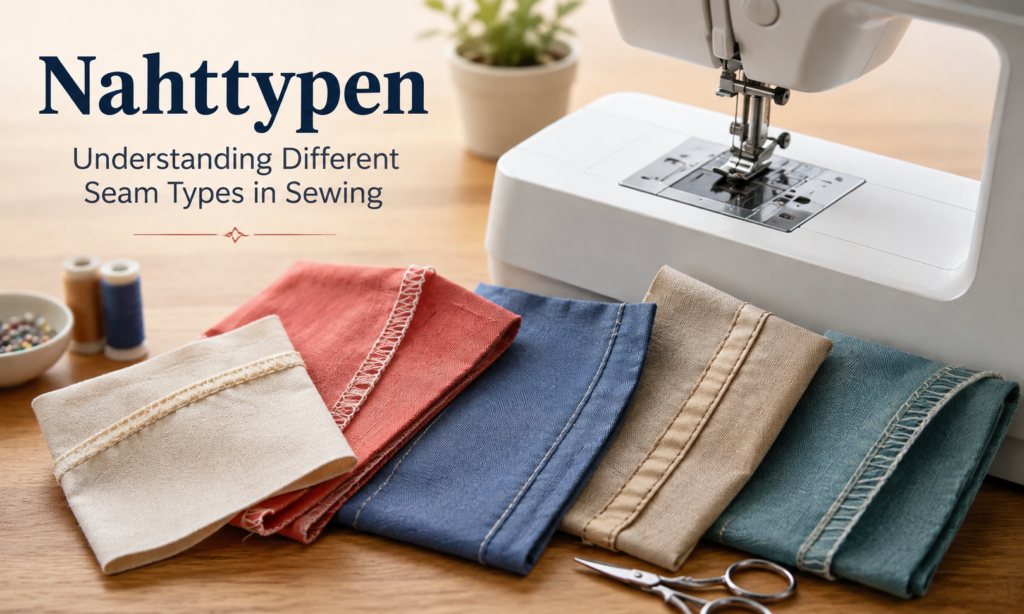

A seam can be one of the least noticeable parts of a garment, yet it often determines how that garment feels, performs, and survives everyday use. The German term Nahttypen, commonly translated as “seam types,” describes the different ways textile pieces are joined. As sewing continues to span home workshops, fashion studios, and industrial production, understanding these construction methods remains central to producing functional, visually refined garments.
Why Nahttypen Matters
At its simplest, a seam is where two or more pieces of material join. In textile construction, that connection may be created through stitching and, in some technical applications, through other joining methods such as bonding or welding. The exact construction influences strength, flexibility, appearance, comfort and durability.
That is why no single seam suits every fabric or garment.
A lightweight blouse, a pair of work trousers and a stretch sports garment may all require very different approaches. The seam needs to match not only the fabric but also the stress, movement, and washing the finished product is expected to withstand.
The German term itself is straightforward. “Naht” refers broadly to a seam or joining line, while “Typen” means types. In sewing and fashion education, Nahttypen therefore generally refers to different seam constructions.
A Brief History of Seam Construction
The history of seams is closely connected with the history of clothing itself. Long before modern sewing machines, people joined animal skins, woven fibers, and other materials by hand using needles, threads, and related tools.
Hand sewing made garments relatively easy to repair and alter. As textile production developed, specialized construction methods emerged for different materials and purposes.
The arrival of industrial sewing machines transformed garment production. Faster stitching made large-scale manufacturing possible, while standardized techniques helped factories produce consistent seams.
Modern textile construction has expanded further. Today, seam selection depends on fashion, comfort, manufacturing efficiency, fabric technology, and a product’s intended lifespan.
The underlying principle, however, remains familiar: different materials and different uses require different ways of joining them.
The Main Nahttypen Used in Sewing
Plain Seam
The plain seam is among the most straightforward constructions. Two fabric pieces are positioned together and stitched along their edges.
Its simplicity makes it common in garments and home sewing. However, raw fabric edges can remain exposed, so you may need an additional finishing method, especially with fabrics that fray easily.
The plain seam is also useful because it is relatively easy to sew, press, and alter. For beginners, it provides a foundation for understanding seam allowance, stitching accuracy, and fabric handling.
French Seam
A French seam uses a multi-step construction to enclose the raw fabric edges within the seam.
This creates a neat interior appearance and can be particularly useful with lightweight or delicate fabrics. It is often associated with garments where an exposed raw edge would be visually distracting or undesirable.
The technique requires more work than a basic plain seam, but the finished result provides a clean, refined interior.
Flat-Felled Seam
The flat-felled seam is associated with durability and a clean finish. It encloses the raw edges, producing a relatively strong construction.
It is particularly recognizable in products such as denim garments and workwear, where seams may experience substantial stress.
The method may require additional stitching and careful handling, but its combination of strength and neat finishing makes it valuable in applications where durability matters. German textile references commonly identify the Kappnaht as a particularly robust construction used for jeans and work clothing.
Overlock or Serged Seam
Overlock construction is widely associated with modern garment production and serging.
An overlock machine can trim the fabric edge while simultaneously securing it with thread. This makes the technique useful for controlling fraying and efficiently creating a finished edge.
Overlock construction is especially common in mass-produced clothing, although home sewers also use sergers for professional-looking finishes.
Flatlock Seam
Flatlock seams create a relatively flat connection between fabric layers.
This can be useful in sportswear and other garments where reducing bulk or irritation matters. The seam can also become part of the visual design rather than being hidden completely.
The choice is therefore both technical and aesthetic.
Bound Seam
A bound seam uses an additional strip or binding to cover the raw edge.
This technique can provide a clean interior and can also become a decorative feature. It is useful in garments and textile products where the inside will be visible or where exposed edges need additional protection.
Seam Type Is Not the Same as Stitch Type
One of the most important distinctions for people learning sewing terminology is the difference between a seam and a stitch.
A stitch describes how thread passes through or connects the material. A seam describes the broader construction used to join or finish pieces of material.
The distinction matters because one seam construction can involve particular stitching arrangements, while the same stitch can be used in different sewing situations.
German technical terminology also distinguishes seam construction from stitch classification. DIN 61400, for example, addresses the classification and terminology of sewing stitches.
For someone reading a German sewing pattern, confusing these terms can make instructions harder to understand.
What Determines the Right Seam?
Choosing a seam is not simply a matter of personal preference. Several practical factors influence the decision.
1. Fabric Weight
Heavy fabrics generally require constructions that can handle greater mechanical stress. Lightweight fabrics may require techniques that reduce bulk and prevent visible raw edges.
2. Stretch
Stretch fabrics behave differently from stable woven materials. A seam that works on cotton may not provide the flexibility needed on a highly elastic textile.
3. Fraying
Some fabrics unravel easily after cutting. In such cases, edge finishing becomes particularly important.
4. Comfort
Technically strong seams may still be uncomfortable if they add too much bulk or sit against sensitive areas of the body.
5. Appearance
Fashion garments often require seams to contribute to the visual design. A visible topstitched seam can become a decorative element, while other constructions are intended to remain discreet.
6. Intended Use
A shirt, handbag, curtain, and pair of work trousers face different forms of stress. Seam selection must reflect how the finished item will actually be used.
Common Problems Caused by the Wrong Seam
Many sewing problems are not caused by poor fabric or inadequate equipment. They can result from choosing a construction that does not match the material.
Common problems include:
- Fraying along unfinished edges
- Broken stitches under tension
- Excessive bulk inside garments
- Puckering around stitching
- Seams that restrict movement
- Uneven or distorted fabric
- Poor durability after repeated washing
- An untidy interior finish
These issues demonstrate why seam construction is more than a technical detail. It can directly affect the practical life of a finished product.
Nahttypen in Industrial Textile Production
In industrial manufacturing, seam construction becomes part of a much larger production system.
Factories need techniques that are consistent, efficient, and appropriate for large volumes. Machines, thread selection, fabric handling, and quality-control procedures all contribute to the final result.
Manufacturers must also balance several competing objectives. A highly durable seam may take longer to produce. A decorative construction may require additional operations. A lightweight seam may improve comfort but require greater precision.
The most appropriate method therefore depends on the product and production requirements.
This is one reason standardized terminology remains useful. Clear descriptions of seam construction help designers, pattern makers, sewing technicians, and manufacturers communicate more precisely.
Beyond Sewing: Other Meanings of Nahttypen
Although sewing is the most relevant interpretation in fashion and textile discussions, Nahttypen is context-dependent.
The German word “Naht” can also describe joining concepts in technical fields. In welding, for example, it can refer to weld seams or forms of welded connection. In medicine, related terminology can describe sutures or methods used to close tissue.
That does not mean all of these meanings should be translated as “seam types.” The surrounding document determines the appropriate English terminology.
This distinction matters most when translating German technical material. A translator working with a fashion pattern will understand Nahttypen differently from someone working with a welding manual.
What the Growing Interest in Seam Knowledge Reveals
The renewed interest in sewing and textile construction reflects a broader appreciation for how clothing is actually made.
For beginners, learning seam types can make sewing less mysterious. Instead of treating every sewing instruction as a separate rule, they can understand the purpose behind each construction.
For professionals, seam selection remains part of design and manufacturing strategy.
The increasing variety of modern fabrics also makes this knowledge more relevant. Technical textiles, performance fabrics and stretch materials can behave very differently from traditional woven cloth.
As material choices expand, construction techniques must adapt.
Looking Ahead
The future of seam construction is likely to be shaped by developments in both textile materials and manufacturing technology.
New fabrics can require specialized joining methods. Sportswear, outdoor clothing and technical garments increasingly demand combinations of flexibility, durability, low weight and comfort.
At the same time, traditional seam techniques are unlikely to disappear. Many established constructions remain valuable precisely because they are reliable, repairable and well understood.
The more likely direction is coexistence: traditional sewing methods continuing alongside automated machinery, advanced textiles and new production technologies.
Conclusion
Nahttypen may seem like a simple German sewing term, but it represents a surprisingly broad part of textile construction. From the basic plain seam to French, flat-felled, bound and overlock constructions, each method solves a different practical or aesthetic problem.
The central lesson is that a seam is not merely a line of stitching. It influences how material behaves, how a garment feels, how long it lasts, and how it looks from the inside and outside.
Understanding these differences also explains why professional garment construction requires more than simply connecting two pieces of fabric. The material, purpose, stress, appearance, and production method must all work together.
As clothing and textile technology evolve, terminology may change, and new techniques may emerge. But the fundamental question will remain the same: what is the most appropriate way to join these materials for the job they need to perform?