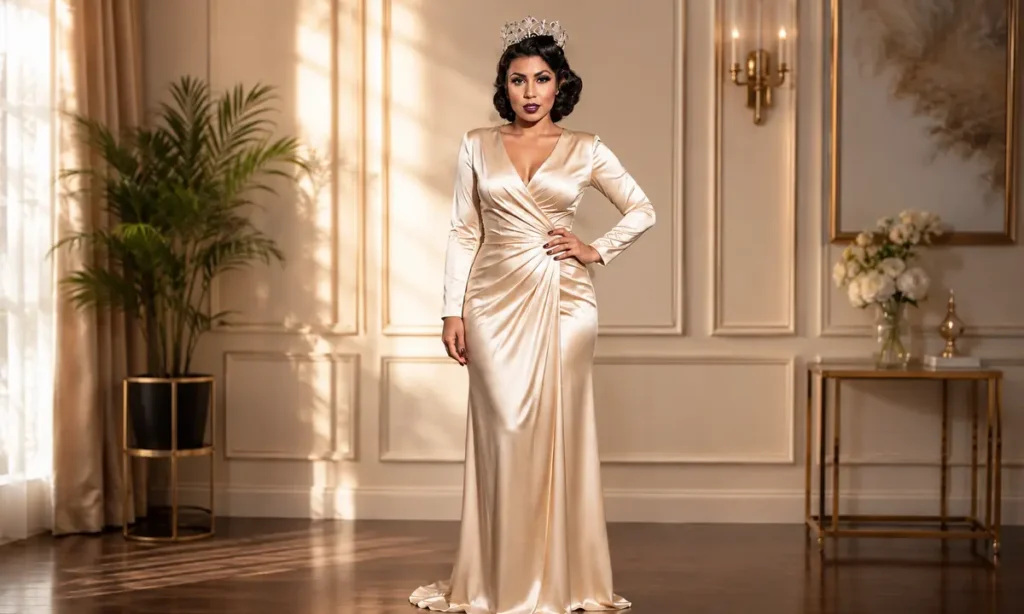

Lauren Ashley Jiles is a performer whose career does not fit neatly into one category. Known professionally as Lou Lou la Duchesse de Rière, she has become an internationally recognized burlesque artist, combining theatrical spectacle with elements of her Kahnawà:ke Mohawk heritage. Her story has attracted renewed attention in recent years, partly because of her connection to professional wrestling through her husband, Danhausen, but her own career long predates that association.
What makes Jiles particularly notable is the way she has used performance not simply as entertainment but as a vehicle for storytelling and representation. Her work has explored Indigenous identity, beauty standards, sexuality, racism, and cultural visibility, while maintaining the humor and theatricality that define her stage persona.
Who Is Lauren Jiles?
Lauren Ashley Jiles grew up in Kahnawà:ke, a Mohawk community near Montreal, Quebec. Her early relationship with performance began long before she became known for burlesque.
Jiles began performing musical theatre at a very young age. She spent years in theatre before turning toward a different kind of stage career. Her transition into burlesque came shortly after her 18th birthday, when she encountered an opportunity to enter a burlesque contest.
What initially seemed like an unexpected career turn became the foundation of a long-running artistic identity.
Today, her professional name, Lou Lou la Duchesse de Rière, is closely associated with theatrical burlesque, elaborate costumes, dance, comedy, and storytelling.
From Theatre to Burlesque
A career shaped by performance
Lauren Jiles‘ background in musical theatre became central to her later work.
Rather than treating burlesque as a complete departure from her earlier experiences, she incorporated elements of theatre, movement, comedy, and narrative into her performances. The result is an act that can involve elaborate costumes and carefully choreographed sequences rather than simply conventional striptease.
During college, Jiles found it challenging to balance demanding academic work with performance. Burlesque ultimately gave her a way to keep performing while developing an artistic identity outside traditional theatre.
That transition proved significant.
Instead of leaving the stage behind, she found another form in which her interests could coexist.
Building the Lou Lou la Duchesse de Rière Persona
Creating Lou Lou la Duchesse de Rière allowed Jiles to combine humor, glamour, theatricality, and cultural symbolism.
Lauren Jiles’s performances frequently use visual spectacle, but the underlying narratives are equally important. Jiles has described her work as satirical sexual pageantry, emphasizing that comedy and storytelling are central to what she does.
That distinction matters because her work operates where entertainment and commentary overlap.
The audience may initially encounter elaborate costumes, dance, comedy, and theatrical spectacle. Beneath those elements, however, are questions about who gets represented on stage and how mainstream culture perceives Indigenous women.
For Jiles, performance became a way of taking control of that narrative.
Indigenous Representation at the Center of Her Work
Challenging traditional ideas of beauty
One of the strongest themes in Jiles’ career has been representation.
The burlesque revival of the 1990s and early 2000s often centered on a predominantly white interpretation of retro beauty. Jiles has discussed the absence of Indigenous women from those images and how that absence influenced her understanding of herself.
Her work consequently became more than an individual artistic career.
It became a way to place an Indigenous woman at the center of a performance tradition where people like herself had often been missing.
This approach also distinguishes Jiles from performers who use burlesque primarily as glamour or spectacle. Her performances can be playful and deliberately extravagant while still carrying cultural meaning.
Humor as a storytelling tool
Humor is another recurring element.
Lauren Jiles has explained that humor plays an important role in her community and can help people process difficult experiences. On stage, she transforms that approach into comedy, satire, and exaggerated theatricality.
That combination allows her to discuss serious subjects without turning every performance into a conventional political statement.
Instead, audiences encounter the message through character, costume, movement, and humor.
Major Career Recognition
Lauren Jiles’ work eventually brought her recognition well beyond local and Canadian performance circles.
At the New Orleans Burlesque Festival, she became the first Indigenous woman to be named the festival’s reigning queen. She was also recognized as Canada’s No. 1 burlesque performer in both 2019 and 2020.
Her achievements also included recognition at the Burlesque Hall of Fame.
In 2019, she finished as second runner-up in the Tournament of Tease competition. The event brought together performers from around the world, making participation itself a significant professional achievement.
Her performances have been recognized for their cultural themes as well as their technical and artistic qualities.
Some of the key milestones associated with Jiles include:
- Becoming the first Indigenous woman crowned at the New Orleans Burlesque Festival
- Being recognized as Canada’s No. 1 burlesque performer in 2019 and 2020
- Placing second runner-up at the Burlesque Hall of Fame Tournament of Tease
- Developing an internationally recognized stage persona
- Using burlesque to highlight Indigenous identity and representation
Beyond Entertainment: Advocacy and Social Commentary
Jiles’ public work has also touched on broader social issues.
Lauren Jiles has discussed experiences involving racism, stereotyping, and discrimination. As a Black and Indigenous woman in Canada, she has spoken about the ways racism can operate through institutions as well as everyday interactions.
These experiences help explain why representation is such an important theme in her artistic work.
Her perspective also challenges the assumption that Canada is automatically free from the racial problems associated with other countries. Jiles has emphasized that racism can take different forms and may sometimes be less visible while still affecting communities and institutions.
The significance of those observations extends beyond burlesque.
They place her artistic career in a broader conversation about Indigenous visibility, identity, and how cultural stereotypes shape public perception.
Lauren Jiles and Danhausen
Lauren Jiles has also become familiar to professional wrestling audiences because of her marriage to wrestler Danhausen.
The couple married in 2018. Danhausen, known for his distinctive, horror-inspired wrestling character and comedic presentation, has built a substantial following through independent wrestling and major promotions.
Jiles’ own career, however, should not be reduced to being the spouse of a wrestler.
Her burlesque career began years before her relationship became relevant to wrestling audiences, and her achievements stand on their own.
Still, the connection has created an interesting overlap between two highly theatrical forms of entertainment.
Both burlesque and professional wrestling rely heavily on character development, costumes, visual storytelling, audience interaction, and carefully constructed personas. In that sense, Jiles and Danhausen share an artistic language even though their professional worlds are different.
Her appearances alongside Danhausen have also introduced her work to wrestling fans who may not have previously encountered her burlesque career.
Why Her Career Matters
Representation has changed, but gaps remain
Jiles’ career illustrates a broader shift within performance culture.
Historically, mainstream entertainment often presented Indigenous women through narrow stereotypes or excluded them entirely. Contemporary performers have increasingly challenged those conventions by creating their own characters and narratives.
Lauren Jiles exemplifies that transition.
Her approach doesn’t require her to abandon glamour, sexuality, or comedy to discuss identity. Instead, she incorporates those elements into a performance that is simultaneously entertaining and culturally conscious.
That is part of what makes her work distinctive.
A different model of cultural storytelling
Traditional cultural storytelling is often associated with formal historical narratives, documentary work, or community institutions.
Jiles demonstrates another possibility: storytelling through popular performance.
Her stage persona can use humor, exaggeration, and sensuality to address cultural themes that might otherwise be difficult to communicate to a broad audience.
The strategy also allows audiences unfamiliar with Indigenous issues to encounter those subjects through an accessible form of entertainment.
The Broader Impact of Her Work
The cultural impact of performers such as Jiles is difficult to measure through conventional statistics.
No single figure can quantify how much a performer changes public perceptions of Indigenous women. Yet representation can have an effect precisely because it changes what audiences see as normal or possible.
Jiles has spoken about not seeing herself represented when she was younger. Her career subsequently placed an Indigenous woman in a highly visible role within an entertainment genre historically associated with different beauty standards.
That creates a meaningful reversal.
Instead of waiting for established entertainment structures to redefine representation, she built a character capable of doing it herself.
What Comes Next for Lauren Jiles?
Lauren Jiles’ future career is likely to remain connected to several overlapping areas: burlesque, performance art, cultural advocacy, and the expanding entertainment universe surrounding her husband.
Her visibility through professional wrestling could introduce her to a much larger audience, but it also raises the question of how that audience will interpret her work.
Will she be viewed primarily as Danhausen’s wife, or will new viewers discover the performer who built an international career as Lou Lou la Duchesse de Rière?
The answer may depend on whether her own artistic work receives the same attention as her connection to wrestling.
For Jiles, however, the opportunity is not entirely new. Her career has repeatedly involved crossing boundaries between theatre, comedy, burlesque, cultural identity, and advocacy.
Continue exploring our website for more compelling biographies, cultural insights, and carefully researched stories that go beyond the headlines: timeupdate
Conclusion
Lauren Jiles’ story is ultimately about more than burlesque.
From her childhood involvement in theatre to her emergence as Lou Lou la Duchesse de Rière, she has developed a performance style that combines spectacle with cultural storytelling. Her recognition at major burlesque events established her as a serious performer, while her discussions of Indigenous representation have given her work a broader social dimension.
Her connection to Danhausen has introduced her to another audience, but it does not define her career. Jiles had already established an independent artistic identity long before professional wrestling expanded her public profile.
Her career also raises a larger question about modern entertainment: as audiences increasingly seek performers who bring authentic cultural perspectives to familiar genres, how much further can artists like Jiles push the boundaries between entertainment, identity, and representation?