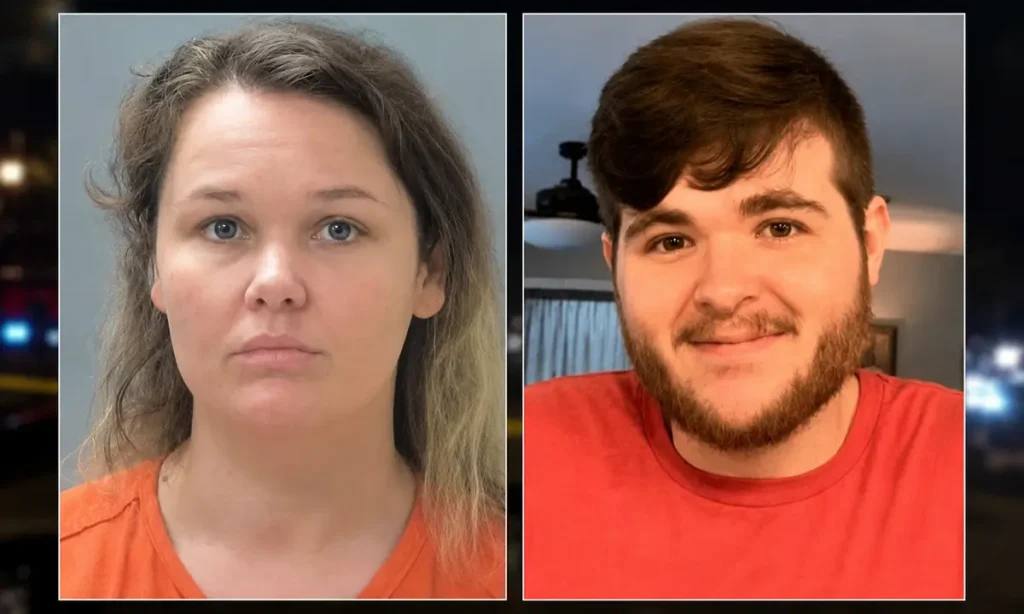

On March 19, 2023, Colby Vinson’s life ended outside his apartment in Navarre, Florida, in a shooting that initially appeared to be another devastating act of violence. But investigators soon uncovered a much more complicated story involving a custody dispute, communications between people connected to Vinson’s former partner, and a carefully developed plan to kill him. More than three years later, the case continues to draw attention because of the people involved and the legal consequences that followed.
Vinson was only 24 when he was killed. He was a father, a son, a grandson and, according to people who knew him, someone deeply involved in the lives of his family and friends. His death became particularly disturbing because it occurred shortly after a court decision had changed his custody arrangement with the mother of his young daughter.
The case eventually resulted in convictions and life sentences, turning what began as a local homicide investigation into a broader examination of how personal conflict can escalate into calculated violence.
Who Was Colby Vinson?
Colby Vinson was born on September 21, 1998, and lived in Navarre, a community in Santa Rosa County in Florida’s Panhandle.
Accounts from his family and friends describe him as outgoing, helpful, and devoted to his daughter. His obituary described him as a kind and loving person who was always willing to help relatives and friends. A fundraising campaign established after his death similarly portrayed him as a dedicated father and valued member of his workplace community.
Vinson was also working and building a life of his own. His death therefore came at a point when he was still in the early stages of adulthood, making the circumstances surrounding the killing especially difficult for those who knew him.
At the center of the story was his relationship with his daughter’s mother, Rachiel Moore.
The two shared a young daughter, and their relationship had become increasingly complicated by a custody dispute.
The Custody Battle That Preceded the Killing
According to prosecutors, Vinson and Moore had been involved in a lengthy disagreement over custody of their child.
For roughly a year, Vinson had been fighting to regain a more substantial role in his daughter’s life. The dispute eventually reached the court system, where a judge considered the competing claims surrounding the child’s custody.
On March 13, 2023, just six days before Vinson was killed, a judge granted him shared custody.
The decision mattered because it gave Vinson substantially greater access to his daughter.
For Vinson, the ruling represented the outcome of a lengthy legal struggle. Investigators later concluded that the same ruling became an important turning point in the events that followed.
Why the Court Decision Mattered
The prosecution’s case established a direct timeline between the custody decision and the subsequent murder.
According to the State Attorney’s Office, Moore communicated with her former stepfather, Jason Curtis, after learning of the custody ruling. Investigators said the communications eventually became part of a plan to locate and kill Vinson.
The prosecution alleged that Moore provided Curtis with information that could help him identify and locate Vinson and also helped with expenses associated with Curtis’s trip from Alabama to Florida.
That sequence became one of the central pieces of the state’s argument that the killing was not spontaneous.
Instead, prosecutors characterized it as a planned act of violence.
The Night of March 19, 2023
Six days after the custody ruling, Vinson arrived home with his four-year-old daughter.
According to the prosecution’s account, he was unloading groceries outside his apartment when Curtis approached and shot him.
Vinson died at the scene.
His young daughter’s presence made the circumstances particularly tragic. She had been with her father shortly before the shooting, turning what should have been an ordinary evening at home into the final moments of his life.
The killing prompted an investigation by the Santa Rosa County Sheriff’s Office.
Investigators uncovered something that would eventually move the case far beyond a conventional homicide investigation.
Investigators Follow the Communications
One of the most important aspects of the investigation involved communications between the people connected to the case.
Investigators examined messages and other evidence to determine whether the shooting had been planned.
According to prosecutors, the evidence showed communication between Moore and Curtis around the time of the custody decision. The state argued the messages showed Curtis was not acting independently.
The investigation also examined how Curtis traveled from Alabama to Florida and how he obtained information that could help him find Vinson.
These details became important because Florida law distinguishes between different levels of criminal responsibility. A person accused of deliberately planning or participating in a premeditated killing can face significantly more severe consequences than someone involved in an accidental or spontaneous act.
In this case, prosecutors ultimately argued that the evidence demonstrated first-degree premeditated murder.
The Role of Jason Curtis
Jason Curtis was identified as the person who physically carried out the shooting.
His connection to Moore was significant because he was her former stepfather. According to prosecutors, Moore contacted Curtis following the custody decision and enlisted his involvement.
The state alleged that Curtis traveled from Alabama to Florida for the purpose of killing Vinson.
That allegation turned the case from a dispute between two parents into a conspiracy involving someone who traveled across state lines.
Curtis was subsequently prosecuted for Vinson’s murder and ultimately received a life sentence.
The convictions reflected the prosecution’s argument that the killing was deliberate rather than an impulsive act resulting from an argument.
The Case Against Rachiel Moore
Moore’s case took longer to reach its conclusion.
On April 24, 2025, a Santa Rosa County jury found her guilty of first-degree premeditated murder and tampering with evidence.
She was immediately sentenced to life in prison without the possibility of parole.
The verdict represented the culmination of an investigation that had begun more than two years earlier.
Prosecutors presented evidence intended to establish that Moore had not merely known about the killing but had actively participated in arranging it.
The state’s case relied heavily on the sequence of events surrounding the custody ruling and communications with Curtis.
The defense, as in many criminal trials involving disputed intent and participation, had the opportunity to challenge the state’s interpretation of the evidence. Ultimately, however, the jury accepted the prosecution’s case and returned guilty verdicts.
A Case About More Than a Custody Dispute
It would be easy to reduce the Vinson case to a simple custody disagreement.
The facts are more complicated.
Custody disputes are common, and disagreements between separated parents can become emotionally intense without turning violent. Courts routinely handle conflicts over visitation, decision-making and parenting schedules.
The significance of the Vinson case lies in the alleged shift from a legal dispute to a criminal plot.
Experts who study family conflict and domestic violence frequently emphasize that separation and disputes over children can become periods of heightened tension. That does not mean most custody disputes are dangerous. Rather, professionals look for warning signs involving threats, coercive behavior, stalking, intimidation or escalating hostility.
The Vinson case illustrates the end of that spectrum.
The Human Cost
Behind the courtroom evidence was the loss of a young father.
Vinson’s obituary emphasized his relationship with his daughter and described a man who enjoyed spending time with family and helping people around him.
A fundraising campaign established after his death raised money for his family and reflected the impact his death had on colleagues and friends.
The campaign described Vinson as a devoted father and a valued member of his professional community.
Such accounts provide a different perspective from court records. Legal documents necessarily focus on charges, evidence and procedure. Family members and friends tend to remember ordinary details—the personality of the person they knew, his responsibilities, his relationships and the future he expected to have.
Both perspectives matter when considering a case like this.
Why the Case Returned to Public Attention
Although Vinson was killed in 2023 and the major conviction came in 2025, the case gained renewed attention in 2026 through true-crime programming and podcasts.
A 2026 episode of Killers: Caught on Camera focused on the Vinson case alongside another investigation. The episode highlighted the role of digital evidence and manipulation in uncovering the circumstances surrounding his murder.
A separate true-crime podcast episode also revisited the case, focusing on the custody decision, the events that followed, and the investigation into Vinson’s death.
The renewed coverage demonstrates how cases can remain in the public consciousness long after a courtroom has reached a verdict.
Digital evidence has become especially important in modern criminal investigations. Text messages, phone records, location information, and other electronic traces can establish relationships and timelines that investigators might otherwise struggle to reconstruct.
What the Case Reveals About Modern Criminal Investigations
The Vinson investigation also demonstrates how homicide cases increasingly depend on evidence beyond eyewitness testimony.
Several categories of evidence can become important in a modern investigation:
- Digital communications: Messages can establish contact between suspects and help investigators reconstruct a timeline.
- Travel information: Records can help determine where suspects were and when they moved between locations.
- Financial evidence: Payments or transfers may help establish relationships between people involved in a crime.
- Physical evidence: Items recovered during an investigation can connect suspects to locations or events.
- Court records: Previous legal proceedings can provide context for relationships and disputes.
No single piece of evidence necessarily proves a case by itself. Instead, investigators and prosecutors often construct a broader timeline from multiple sources.
That approach was particularly relevant in the Vinson case because the prosecution sought to establish premeditation and participation.
The Broader Implications
The case raises difficult questions about how interpersonal conflicts can escalate and how authorities identify potential danger before violence occurs.
It also highlights the importance of family courts and law-enforcement agencies recognizing when disputes over children become unusually hostile.
At the same time, caution is necessary when discussing such cases.
A custody dispute itself is not evidence that someone will become violent. Millions of parents experience difficult separations and disagreements without violence occurring.
The challenge for professionals is distinguishing ordinary conflict from circumstances involving credible threats or escalating behavior.
For the family left behind after Vinson’s death, however, those broader questions cannot erase the personal consequences.
A child lost her father at an age when she was too young to understand the full meaning of what had happened.
What Happens Next?
The criminal proceedings have largely established the legal consequences for the people convicted in Vinson’s killing.
The longer-term story is therefore less about another courtroom development and more about how the case is remembered.
True-crime documentaries and podcasts have ensured that Vinson’s name continues to circulate among audiences far beyond Florida. Such coverage can help explain complicated investigations, but it can also shift attention toward the mechanics of a crime rather than the life of the person who died.
For Vinson’s family, his identity is not defined solely by the circumstances of his death.
He was a 24-year-old father whose life included work, friendships, family relationships and hopes for the future.
Continue exploring our website for more compelling biographies, cultural insights, and carefully researched stories that go beyond the headlines: TimeUpdate
Conclusion
The story of Colby Vinson is ultimately a story about how an ordinary family conflict became an extraordinary criminal case.
His death followed a pivotal custody ruling and led investigators through a trail of communications, relationships and evidence that prosecutors said revealed a deliberate plan. The resulting convictions brought legal accountability, but they could not restore the life that was lost.
More than three years after the shooting, renewed media attention has introduced the case to another generation of true-crime audiences. Yet beneath the investigation, courtroom testimony and digital evidence remains a much simpler fact: Vinson was a young father who expected to have more time with his daughter.
The lasting significance of the case may therefore lie not only in how the murder was solved, but in the difficult questions it leaves behind about family conflict, warning signs, criminal planning and the irreversible consequences of violence. As the case continues to be revisited, one question remains particularly difficult to answer: how can systems designed to resolve family disputes recognize the rare moments when conflict is moving toward something far more dangerous?