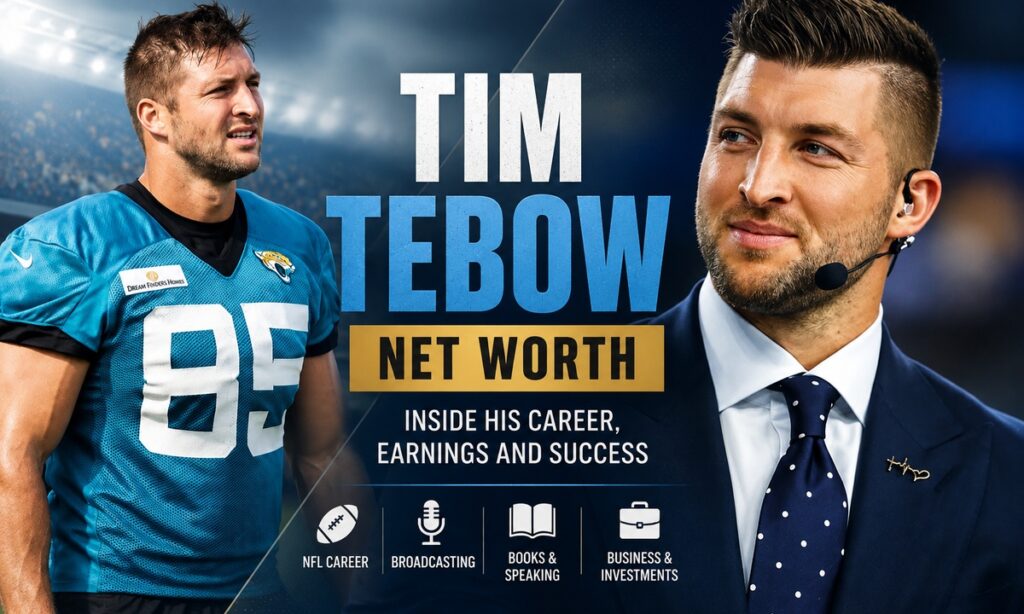

Tim Tebow has spent much of his adult life in the public eye, first as one of college football’s biggest stars, then as an NFL quarterback, professional baseball player, broadcaster, and entrepreneur. While his playing career did not follow the conventional path of a long NFL tenure, his commercial profile remained remarkably durable.
As of 2026, widely published estimates place Tim Tebow net worth at approximately $10 million. Treat that figure as an estimate rather than an audited personal financial statement, since Tebow does not publicly disclose a complete breakdown of his assets, investments, contracts, and liabilities.
What makes Tebow’s finances particularly interesting is the way his earning power evolved. Tim Tebow net worth initially came from football, but over time it became increasingly tied to media, endorsements, publishing, public speaking, and business ventures.
From College Football Stardom to NFL First-Round Pick
Tebow’s financial story began with an unusually strong sports profile at the University of Florida.
He won the 2007 Heisman Trophy, helped Florida win two national championships, and became one of college football’s most recognizable players. He finished his Florida career with an impressive 48-7 record while setting numerous school and conference records.
The Denver Broncos selected him with the 25th overall pick in the 2010 NFL Draft.
His initial professional contract established the foundation of his playing income, although his NFL career was relatively short. Public salary databases estimate that Tebow earned roughly $9.6 million in NFL career earnings.
That figure matters when comparing career earnings with net worth. NFL income represents gross compensation, not the amount ultimately retained after taxes, agent fees, living expenses, and other costs.
His NFL Career Was Brief but Commercially Powerful
Tebow played two seasons for Denver and later spent time with the New York Jets. His most memorable NFL period came during the 2011 season, when his playing style, personality and late-game performances generated enormous media attention.
The commercial impact was noticeable.
During his early NFL years, companies including Nike, Jockey and FRS used Tebow in marketing campaigns. His endorsement portfolio showed that his earning potential wasn’t limited to his football salary.
Contemporary reports estimated that Tebow’s endorsement agreements during the height of his NFL popularity could generate millions of dollars in annual commercial income.
The figures illustrate why Tebow’s financial story cannot be measured only by his NFL salary.
Endorsements Became a Major Part of the Tebow Brand
Tebow’s public image was always broader than his performance statistics.
His mix of college football success, NFL visibility, charitable work, and a recognizable personality made him attractive to companies seeking an athlete with a large, engaged audience.
During the early 2010s, his commercial relationships included brands such as:
- Nike
- Jockey
- FRS
- EA Sports
- Other sports and lifestyle companies
The financial terms of most individual endorsement agreements were not publicly disclosed.
That makes precise calculations difficult, but contemporary reporting provides evidence that endorsements were commercially meaningful.
This demonstrates an important distinction between salary and celebrity earning power. Even when an athlete is no longer competing at the highest professional level, a recognizable personal brand can continue generating commercial opportunities.
Baseball Added Another Chapter to His Career
In 2016, Tebow made another unexpected career move when he attempted to become a professional baseball player.
The New York Mets signed him to a minor-league contract that reportedly included a $100,000 signing bonus.
His baseball career lasted several seasons and included stops with several Mets minor-league affiliates.
He eventually reached Triple-A, baseball’s highest minor-league level.
Tebow’s baseball statistics were modest compared with his college football achievements. Nevertheless, the experiment generated substantial media attention and gave him another professional sports platform.
He retired from baseball in February 2021.
Financially, baseball was unlikely to rival the earning potential of a successful NFL career. Still, it reinforced something already central to Tebow’s brand: his ability to attract public attention outside his original sport.
Broadcasting Created a Longer-Term Career
One of the most significant developments in Tebow’s post-playing career has been television.
He joined ESPN in 2013 as a college football analyst and became a regular contributor to the network’s college football coverage.
Broadcasting created a professional path that could continue long after his playing career ended.
Unlike an NFL contract, where income can depend heavily on playing status and roster decisions, a media career can provide a more sustainable professional platform.
Tebow’s continued association with ESPN has kept him connected to college football, the sport where he first became a national star.
The exact value of his broadcasting contracts has not been publicly disclosed, making it difficult to calculate how much television contributes to his overall net worth.
Books and Speaking Expanded His Income Sources
Tebow is also an established author.
Over the years, he has published books covering subjects such as football, faith, motivation, and personal experiences. Several of his books have become commercially successful, contributing to his broader public profile.
Books can provide several potential revenue streams, including advances, royalties, speaking opportunities and increased visibility.
However, publishers generally do not disclose an author’s complete lifetime earnings, so no reliable public figure exists for Tebow’s total income from book sales.
Public speaking represents another commercial avenue.
Tebow has given keynote speeches and speaking engagements for businesses, organizations, sports audiences, and faith-based groups.
Speaking fees vary significantly by event and circumstances, and individual agreements are generally private.
Business Ventures Added Another Layer
Tim Tebow net worth: Tebow’s financial profile has increasingly moved into entrepreneurship.
Through business and media activities, he has expanded beyond traditional athlete income. His professional interests have included brand partnerships, speaking, investing, and other commercial ventures.
This represents a different stage of Tebow’s career.
Rather than depending primarily on athletic compensation, his current model involves leveraging his name, relationships, media platform, and business experience.
That diversification can matter considerably for long-term wealth.
The Tim Tebow Foundation Is Separate From His Personal Wealth
Tebow’s philanthropic work is frequently mentioned alongside his business activities, but the two should not be confused.
The Tim Tebow Foundation is a nonprofit organization, not an asset that should be counted as part of Tim Tebow net worth.
The foundation has worked internationally on issues involving children, medical care, human trafficking, orphan care and support for people with special needs.
This distinction is essential when discussing celebrity wealth.
Money raised or spent by a charitable foundation should not automatically be treated as the founder’s personal money.
Why Tim Tebow Net Worth Is Difficult to Calculate
Celebrity net-worth estimates often create an impression of precision that does not exist.
Tim Tebow net worth estimated $10 million figure is a useful broad reference point, but it should not be interpreted as a verified balance sheet.
Several variables make the calculation difficult:
- Private investments are not fully disclosed.
- Endorsement contracts often contain confidential terms.
- Speaking income is generally private.
- Taxes and professional expenses reduce gross earnings.
- Business ownership stakes may fluctuate in value.
- The value of personal property and other assets is not comprehensively public.
For these reasons, different websites and publications can produce different estimates.
The most responsible approach is to describe Tim Tebow net worth as an estimated figure rather than a confirmed number.
What Could Shape Tim Tebow’s Finances Next?
Tim Tebow’s future earning potential now depends less on professional sports performance.
His continued involvement in college football broadcasting provides visibility, while speaking, publishing, business ventures, and brand partnerships create additional opportunities.
His broader professional activities can be divided into several areas:
- Sports broadcasting
- Public speaking
- Publishing
- Brand partnerships
- Entrepreneurship
- Investing
- Philanthropic initiatives
That diversification could make his financial profile less dependent on any single employer or industry.
At the same time, private business ventures can involve financial risks that aren’t visible in public-facing announcements. Without detailed financial disclosures, private investments, partnerships, and company valuations cannot be accurately incorporated into a net-worth estimate.
The Bigger Picture Behind Tim Tebow Net Worth
Tim Tebow’s financial trajectory is unusual because his biggest commercial asset has arguably been his long-term public identity, rather than the length of his professional playing career.
He earned millions from NFL contracts, but his broader career has included endorsement opportunities, baseball, television, books, speaking, and business ventures.
His story also demonstrates how quickly an athlete’s economic value can extend beyond the playing field.
During his peak football years, brands benefited from the attention surrounding Tebow. Years later, television and other professional opportunities still give him a platform, even though his playing career has ended.
As of 2026, the commonly cited $10 million net-worth estimate offers a useful snapshot, but not a definitive accounting of his finances.
The more revealing story is how Tebow transformed a relatively short professional playing career into a much longer media and business career. His financial future will likely depend less on touchdowns or batting averages and more on the continued value of his media presence, intellectual property, partnerships, and entrepreneurial activities.
For an athlete whose professional sports career ended years ago, that evolution raises a broader question: how much lasting financial value can a sports identity create when the playing career itself is only one part of the story?