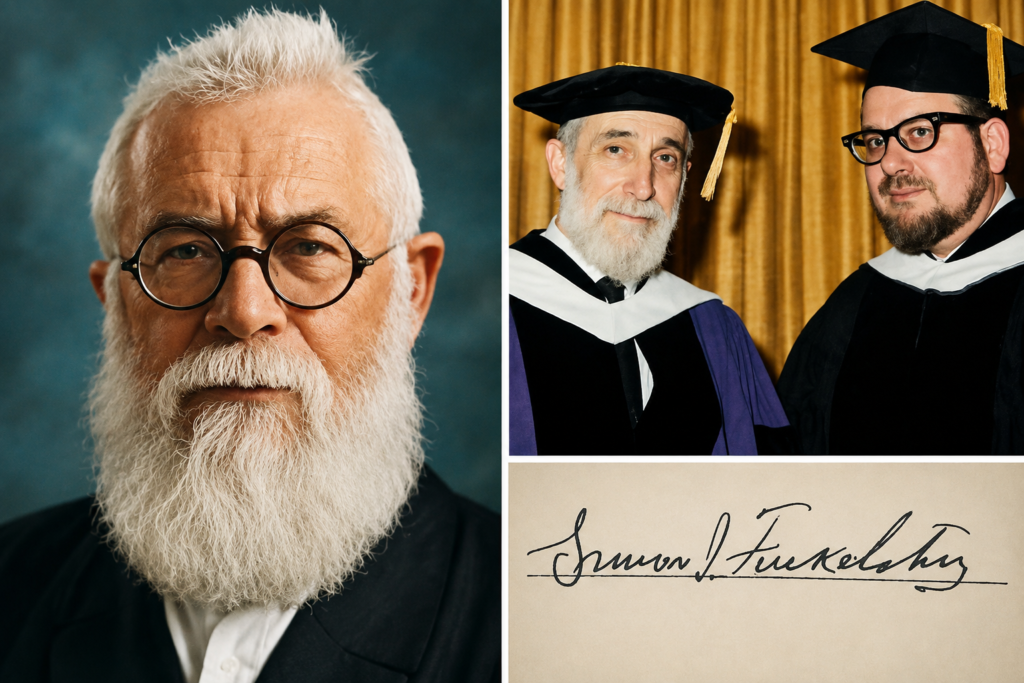

For years, the name Rabbi Abe Finkelstein has circulated online alongside a controversial recording attributed to broadcaster James Wickstrom. The recording has repeatedly resurfaced on websites, social platforms and podcasts, often accompanied by extraordinary claims about its origins and meaning. Yet the central question remains surprisingly difficult to answer: who, exactly, was the man identified as Rabbi Abe Finkelstein?
Recent discussions have renewed interest in the recording, but they have also highlighted a fundamental problem. While the audio itself exists in multiple copies, independent documentation establishing the identity and background of its alleged guest remains elusive. A photograph frequently presented as Finkelstein has also been identified elsewhere as belonging to another individual, further complicating attempts to establish the identity behind the voice.
Why the Name Rabbi Finkelstein Has Returned to Public Attention
The renewed interest is not necessarily the result of a new historical discovery. Instead, it reflects a familiar pattern of internet culture: an old recording acquires new audiences as social media, podcasts and video platforms repeatedly bring controversial material back into circulation.
The recording is generally described as an alleged interview between James Wickstrom and a man introduced as Rabbi Abe Finkelstein. Discussions have focused on whether the broadcast occurred as described, whether the speaker’s identity can be independently established, and why so little reliable documentation surrounds the alleged rabbi.
That distinction is important. The existence of a recording and the existence of a historically verified person identified as its speaker are two separate questions.
The recording can be examined as an artefact. Establishing who was actually speaking requires additional evidence.
The James Wickstrom Connection
Much of the story begins with James Wickstrom, a broadcaster and religious activist whose name became closely associated with the recording.
Versions of the interview circulating online introduce the guest as “Rabbi Abe Finkelstein,” sometimes describing him as a rabbi from the eastern United States. Transcripts and reposts have subsequently appeared across the internet, allowing the conversation to circulate far beyond its original context.
The material became controversial because the alleged conversation touched on Jewish identity, race, religion, politics, historical events and other highly sensitive subjects.
Those subjects helped make the recording attractive to conspiracy-oriented communities, where it has sometimes been presented as evidence for sweeping claims about Jewish people or global institutions.
That interpretation, however, does not establish the speaker’s authenticity.
A Critical Problem: Who Was Abe Finkelstein?
The most significant unresolved issue is biographical.
A genuine public rabbi would ordinarily leave some documentary trail. Depending on the period, that might include synagogue records, professional directories, religious institutions, newspaper coverage, educational records, published sermons or other historical references.
Researchers examining the alleged Rabbi Abe Finkelstein have not produced independently verified documentation that conclusively connects a real rabbi with the voice in the recording.
The absence of documentation does not automatically prove that no such person ever existed. Historical records can be incomplete, particularly for private individuals or people who did not hold prominent public positions.
But the lack of corroborating evidence means the identity should remain described as unverified rather than fact.
The Photograph Problem
The visual evidence is similarly uncertain.
For years, images shared online alongside the name Rabbi Abe Finkelstein have been used to give the story a recognisable face. However, one widely circulated photograph has been identified elsewhere as belonging to someone else, not a rabbi named Abe Finkelstein.
If the photograph is misidentified, it weakens one of the most frequently repeated pieces of supposed evidence supporting the identity.
It also illustrates how misinformation can become self-reinforcing. Once an incorrect photograph is attached to a name, later websites may reproduce both together, creating the appearance of independent confirmation when they are actually repeating the same original mistake.
Why the Finkelstein Name Creates Additional Confusion
The surname itself is not unusual.
Documented rabbis named Finkelstein include those in congregational leadership and in Jewish education and scholarship. Religious institutions, educational organisations, and community records document their professional histories.
These documented individuals should not be confused with the alleged Rabbi Abe Finkelstein connected to the Wickstrom recording.
The distinction matters because online searches can easily combine unrelated people who share the same surname.
Someone discovering the story today may encounter multiple individuals named Finkelstein and assume they are connected. Without independent evidence, however, a shared surname provides no basis for making that connection.
The Broader Historical Context
The controversy surrounding the recording also needs to be understood within a much older history of fabricated or distorted claims about Jewish people.
False accusations involving Jews have circulated for centuries, often presenting fictional quotations, invented individuals or fabricated evidence as proof of hidden wrongdoing.
Modern digital platforms can reproduce the same mechanism at dramatically greater speed.
A claim originally made in an obscure broadcast can be copied into a transcript, quoted by a blog, incorporated into a video, discussed on a podcast, and eventually presented by another website as established historical fact.
Each repetition can make the underlying claim appear more credible even when none of the later sources provides independent evidence.
This is why historians distinguish between primary evidence, secondary reporting and repetition.
What Can Actually Be Established?
Several points can be separated from claims that remain uncertain.
- The recording exists in circulated digital forms.
- James Wickstrom was a real broadcaster associated with the material.
- The guest was introduced in circulated versions as Rabbi Abe Finkelstein.
- Reliable historical documentation has not independently established the speaker’s identity.
- A commonly circulated photograph associated with the alleged rabbi has been questioned and attributed to someone else.
- The claims made within the recording should not automatically be treated as independently verified simply because they appear in an audio recording.
That last point is particularly important.
Audio can establish that someone said something. It does not automatically establish that the speaker was who the introduction claimed, that the statements were accurate or that the events described actually happened.
The Hoax Question
One of the more interesting explanations surrounding the recording is that the broadcast may have involved a fictional or staged character.
Accounts from recent investigations suggest the alleged interview could have been created as a joke or performance, with a participant playing the role of the supposed rabbi.
That possibility is significant, but it should also be treated carefully.
Without complete documentation of the original broadcast, the people involved and the recording’s chain of custody, it is difficult to establish exactly how the material was produced.
The uncertainty therefore works both ways. The available evidence raises serious questions about the commonly repeated identity, but it does not fully reconstruct the recording’s creation.
Why the Story Continues to Spread
Several reasons explain why the Rabbi Finkelstein story has proved unusually persistent.
The Recording Feels Like Primary Evidence
People often assume that hearing a voice directly provides stronger evidence than reading a written claim.
But an unidentified recording can actually create a difficult evidentiary problem. Without a confirmed speaker, date, location and original broadcast documentation, the context remains uncertain.
Repetition Creates Apparent Confirmation
A search may produce dozens of pages mentioning Rabbi Abe Finkelstein. That does not mean dozens of independent sources have verified him.
Many websites may simply copy the same transcript, photograph, or original claim.
Controversial Material Attracts Archival Attention
Old recordings containing provocative claims frequently receive new attention because modern audiences encounter them without the historical context in which they originally appeared.
The result can be a cycle in which each new generation treats the material as a newly discovered revelation.
The Difference Between Documented Rabbis and the Alleged Identity
The contrast with documented rabbis named Finkelstein is instructive.
A rabbi with a documented professional career will normally have an identifiable history involving congregations, educational institutions, publications, community organisations, or other records.
Such documentation makes it possible to independently verify basic biographical information, including education, employment and religious affiliations.
The alleged Rabbi Abe Finkelstein does not currently have an equivalent publicly established documentary record connected to the recording.
That gap is therefore not simply a minor biographical detail. It is central to evaluating the story.
What Could Happen Next?
In the short term, the name is likely to continue appearing in online discussions because old recordings are easily redistributed and newly produced podcasts and videos can introduce them to audiences unfamiliar with their history.
A more definitive historical account would require stronger primary evidence.
That could include:
- An original broadcast recording with reliable provenance.
- Contemporary station schedules or program listings.
- Newspaper coverage identifying the guest.
- Independent records confirming the rabbi’s identity.
- Documentation linking a real individual to the voice heard in the recording.
Without such evidence, the most responsible description remains that “Rabbi Abe Finkelstein” is an alleged identity associated with a disputed recording, rather than a conclusively documented historical figure.
Conclusion
The story of Rabbi Finkelstein illustrates a broader challenge of the digital age: distinguishing an enduring internet narrative from a documented historical record.
The recording associated with the name has clearly had a long afterlife, and renewed investigations have raised questions about its provenance, its alleged speaker and the photographs used to represent him. At the same time, unresolved questions should not be turned into facts.
Perhaps the most important lesson is methodological. A name appearing repeatedly online is not the same as an independently verified identity, and a recording’s existence does not automatically validate the claims it contains.
As researchers continue examining the surviving material, the central question remains open: will new primary evidence eventually establish who was behind the voice, or will Rabbi Abe Finkelstein remain primarily an unresolved identity preserved by an enduring piece of internet folklore?