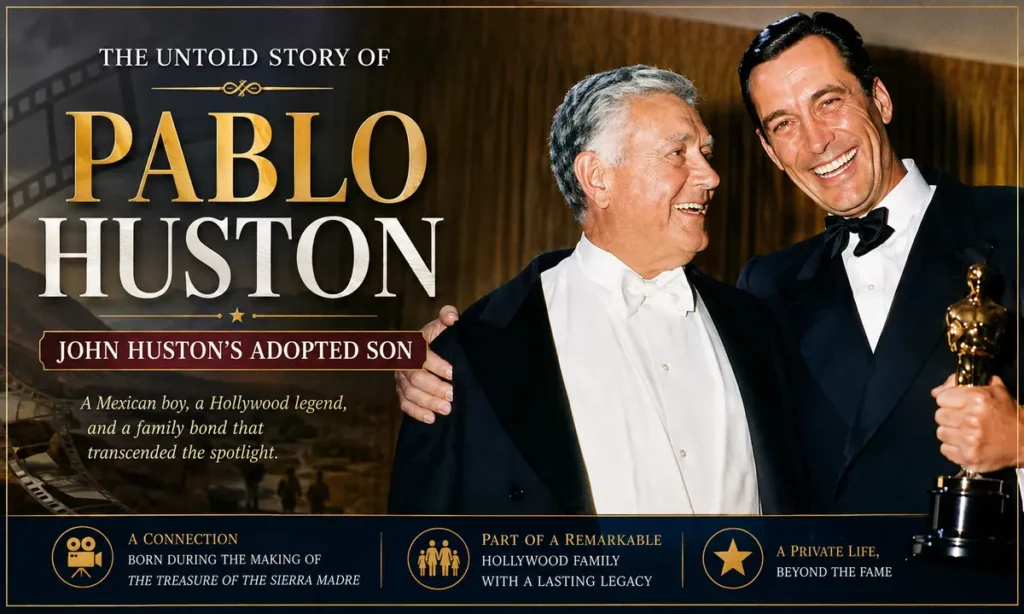

For decades, Pablo Huston has occupied an unusual place in Hollywood history: close enough to one of cinema’s most famous families to appear in major biographies, yet distant enough from the spotlight that remarkably little is known about his adult life. Adopted by filmmaker John Huston and actress Evelyn Keyes during the late 1940s, Pablo became part of a family that would eventually include several prominent actors, writers and filmmakers.
The adoption itself is documented. What happened afterwards is far less certain.
A Name Hidden in Hollywood History
Pablo Huston is not a household name like his adoptive father, John Huston, or his better-known family members Anjelica and Danny Huston. Yet historical records place him firmly within the Huston family.
A Library of Congress finding aid contains a biographical file for “Pablo Albaran,” identifying him as the adopted son of John Huston and Evelyn Keyes. His name is spelt differently across historical and modern sources, including Pablo Albaran and Pablo Albarran. Because an original birth or adoption document is not readily available in the public record, his birth name’s precise legal form remains uncertain.
The broad outline, however, is considerably clearer.
John Huston met Pablo in Mexico while working on The Treasure of the Sierra Madre, the 1948 film that would become one of the director’s defining works. A 1987 obituary in the Los Angeles Times described Pablo as a Mexican orphan whom Huston befriended during production and later adopted.
That connection placed Pablo inside one of the most remarkable creative families in American cinema.
The Mexico Connection
A childhood encounter during The Treasure of the Sierra Madre
The story begins in Mexico in the late 1940s, when John Huston was filming The Treasure of the Sierra Madre.
The production was an important moment in Huston’s career. By then, he had already established himself as a major director with films including The Maltese Falcon. The Treasure of the Sierra Madre further strengthened his reputation and eventually earned him Academy Awards for both directing and screenplay.
During this period, he met Pablo.
Historical accounts describe Pablo as a Mexican child who was living without the family circumstances enjoyed by most children. Contemporary material and later biographies place him at roughly 12 years old during the 1947 production, although reliable public records have not firmly established his exact birth date.
That distinction matters. Modern websites frequently give Pablo a specific birthday or birth year, but those details are often repeated without an identifiable primary source. The available evidence supports his approximate age during the adoption period more strongly than it supports a precise date of birth.
From acquaintance to adoption
Huston’s relationship with the boy developed beyond their initial meeting.
John Huston and Evelyn Keyes were married in July 1946, and they adopted Pablo during their marriage. A museum biography of Keyes similarly records that the couple adopted a Mexican child named Pablo after Huston encountered him while working on The Treasure of the Sierra Madre.
The marriage itself was relatively brief. Huston and Keyes divorced in 1950, only a few years after they had married.
Nevertheless, Pablo remained part of Huston’s family history.
John Huston: The Filmmaker at the Centre of the Story
To understand why Pablo’s adoption continues to attract attention, it is necessary to understand the stature of his adoptive father.
John Huston was a central figure in classic American cinema. His career spanned directing, screenwriting, and acting, and his filmography included The Maltese Falcon, The Treasure of the Sierra Madre, and The African Queen.
His influence also extended beyond individual films. Huston belonged to a multigenerational artistic family. His father, Walter Huston, was an acclaimed actor, while John later became the father of several people who developed careers in entertainment.
When John Huston died in 1987 at the age of 81, The Washington Post reported that he had five children: Anjelica and Tony with Enrica Soma, Danny with Zoe Sallis, and Allegra and Pablo, whom he adopted.
The Los Angeles Times obituary likewise identified Pablo among Huston’s children and specifically connected his adoption to the Mexican filming of The Treasure of the Sierra Madre.
Those contemporary newspaper records are among the strongest evidence for Pablo’s place in the family.
Evelyn Keyes and the Huston Household
Pablo’s other adoptive parent was Evelyn Keyes, an established Hollywood actress best remembered for playing Suellen O’Hara in Gone with the Wind.
Keyes had a substantial career during Hollywood’s studio era, appearing in films throughout the 1940s and 1950s. Her marriage to Huston lasted from 1946 until 1950.
The couple’s decision to adopt Pablo therefore took place within a highly visible Hollywood household.
Yet Pablo’s later life did not follow the path of his adoptive parents.
No established filmography exists under his name, nor is there a documented career comparable to that of other members of the Huston family. That absence defines his biography.
A Family Filled With Film History
Pablo became connected to a remarkable network of relatives.
Anjelica Huston
Anjelica Huston, John Huston’s daughter with Enrica Soma, became an internationally recognised actress and later won an Academy Award for Prizzi’s Honour, directed by her father.
Her career helped extend the Huston family’s influence into another generation.
Tony Huston
Tony Huston became a screenwriter and filmmaker, continuing the family’s association with the film industry.
Danny Huston
Danny Huston, another of John Huston’s sons, developed a career as an actor and filmmaker.
Allegra Huston
Allegra Huston was also raised within John Huston’s extended family and became a writer.
Pablo’s position is therefore unusual. He belonged to a family in which film was not simply an occupation but a multigenerational legacy, yet no comparable public record shows him pursuing entertainment.
Why So Little Is Known About Pablo Huston
The central mystery surrounding Pablo is not necessarily a dramatic event. It is the lack of documentation.
Several factors help explain the gap.
- He entered the family in the 1940s, decades before the internet and modern celebrity culture.
- He did not build a prominent entertainment career, so newspapers had little professional reason to cover his activities.
- His adult life appears to have remained private, unlike relatives who regularly appeared in films, interviews and award ceremonies.
- Later online biographies frequently repeat one another, making it difficult to distinguish independently verified information from copied claims.
This last point is especially important.
Several websites now publish specific claims about Pablo’s career, spouse, children, residence or net worth. But little reliable public evidence supports many of those details.
The absence of information does not establish that Pablo never married, never worked or never had children. It simply means those aspects of his life cannot responsibly be presented as facts based on the available record.
The Problem With Celebrity Biography Gaps
Pablo Huston’s story illustrates a wider problem in the digital biography industry.
When a public figure has an extensively documented career, biographical information can often be checked against interviews, newspaper archives, professional credits and public records. Someone who deliberately stays outside public life presents the opposite problem.
A small number of historical facts can become the foundation for dozens of nearly identical internet biographies.
One site may introduce an estimated birth year. Another may copy it. A third may turn the estimate into a precise age. Eventually, the original uncertainty disappears from the retelling.
Pablo’s biography demonstrates why historical reporting needs to distinguish between documented facts, reasonable historical estimates and unsupported claims.
What Is Known About His Adult Life?
This is where the reliable public record becomes particularly thin.
No well-established public biography describes Pablo’s profession, major achievements, marriage, children, or residence in adulthood.
No documented film career comparable to those of Anjelica, Danny, or Tony Huston exists.
Some modern accounts claim that Pablo worked in various professions or maintained an artistic life away from Hollywood. Other sources provide details about his family relationships. These claims differ considerably, and they are not consistently supported by primary documentation.
For that reason, treat them as unverified rather than incorporate them into a definitive biography.
The same caution applies to claims about his current whereabouts or status.
As of 2026, reliable public sources do not provide a clear enough account of Pablo Huston’s present life to support detailed claims about where he lives or what he does.
A Different Kind of Hollywood Story
Pablo Huston’s significance lies partly in what his story lacks.
Hollywood biographies often follow a familiar pattern: a famous parent introduces a child to the industry, the child enters acting or filmmaking, and another generation of celebrity emerges.
Pablo’s story appears to have taken a different route.
His connection to John Huston gave him access to one of the most extraordinary families in American film history. Still, there is no evidence that he sought to reproduce his adoptive father’s career.
That makes his story useful for understanding another side of celebrity culture: being part of a famous family does not necessarily mean becoming a public figure oneself.
What Could Happen Next?
For Pablo Huston, the future of his public story largely depends on historical discovery rather than new celebrity activity.
A previously unpublished family document, newspaper archive, interview, or legal record could clarify questions about his birth name, childhood, and later years.
The most useful developments would likely come from primary sources, such as:
- Contemporary newspaper or magazine reports from the 1940s.
- John Huston’s memoirs and personal papers.
- Evelyn Keyes’ autobiographical writings.
- Archival material concerning the adoption.
- Interviews or statements from members of the Huston family.
Until such evidence emerges, the responsible historical account remains relatively narrow.
What is clear is that Pablo was a Mexican-born child who became the adopted son of John Huston and Evelyn Keyes around the time of the production of The Treasure of the Sierra Madre. His later life, by contrast, remains largely outside the documented public record.
Conclusion: The Story Behind the Silence
Pablo Huston’s place in Hollywood history is unusual precisely because he did not become a Hollywood celebrity.
His name survives through the biography of John Huston, the career of Evelyn Keyes, the history of The Treasure of the Sierra Madre, and the later achievements of the wider Huston family. Historical records from the Library of Congress and major newspapers establish the central facts of his adoption, while leaving many details of his adult life unresolved.
That silence should not automatically be filled with speculation.
For now, Pablo Huston’s story is best understood as a documented chapter of a famous family’s history whose later pages were largely kept private. Whether future archival discoveries will reveal more about the man behind the name remains an open question—and perhaps the most enduring mystery in this lesser-known corner of the Huston family story.