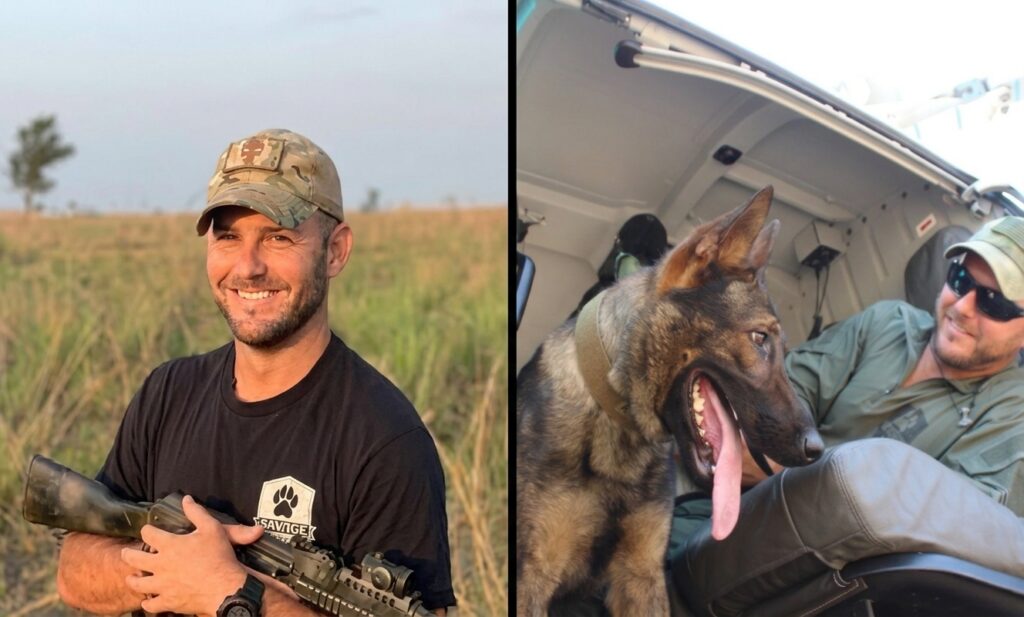

Jay Crafter’s career has followed an unusual path: from growing up around Zimbabwe’s national parks to working with military and law-enforcement canine programs, and eventually helping develop dog teams used against wildlife crime. His work sits at the intersection of conservation, security, and specialized animal training, illustrating how skills developed for one purpose can be adapted to another.
Crafter is now associated with Working Dogs for Conservation, where he serves as Director of Law Enforcement. His professional background includes military working-dog programs, U.S. law enforcement, and training for specialized government operations and conservation projects across Africa.
A childhood shaped by Zimbabwe’s wildlife
Crafter was born and raised in Zimbabwe in a family with connections to conservation and Zimbabwe’s national parks. That early exposure to wildlife laid the foundation for a career that would eventually bring him back to the continent in a very different professional role.
Rather than entering conservation through traditional wildlife biology or environmental science, Crafter developed expertise in working dogs. His later career demonstrates how canine tracking and detection skills can be applied in settings ranging from military operations to wildlife protection.
His Zimbabwean background also gave him familiarity with the environments conservation officers operate in. Working across remote landscapes requires more than simply training a dog to detect a scent; handlers must understand terrain, human behavior, logistics, and the practical limitations of field operations.
From military and law enforcement to canine specialization
Crafter’s professional history includes both British and U.S. military experience. Sources describing his career say he trained working-dog teams connected to U.S. Special Operations programs and worked with multiple American law-enforcement agencies. He also qualified as a Class 1 trainer through the British Army’s Royal Army Veterinary Corps.
That combination became important because working-dog programs depend heavily on the relationship between the animal and its handler.
A highly trained dog can identify or follow a scent. Still, operational success also depends on whether the handler understands what the dog is communicating and can make appropriate decisions in difficult circumstances.
The importance of training beyond the dog
Crafter’s work has therefore focused not simply on canine capability but also on selecting and developing handlers.
Working Dogs for Conservation describes his experience as spanning more than 25 years in law enforcement and military working-dog programs. The organization says he has worked on projects involving canine capability, training, and conservation operations.
This approach is particularly relevant in conservation, where programs may have limited resources and operate far from established training facilities.
The move into wildlife crime prevention
One of the defining chapters of Jay Crafter’s career came through Invictus K9, an organization he co-founded with Michael Hensman.
The organization developed canine teams for anti-poaching and wildlife-crime operations in several African countries. A 2020 account of Invictus K9 described its teams as being used to track suspected poachers and detect illegal wildlife products, firearms and ammunition in countries including Zambia, Zimbabwe, Kenya, Namibia, the Democratic Republic of Congo and South Africa. The concept was relatively straightforward but operationally demanding: use dogs’ highly developed senses to help rangers locate people, follow tracks or detect materials that might otherwise be difficult to find.
Crafter’s previous experience provided a transferable skill set. Military and law-enforcement dogs are trained to work in complex environments. Conservation teams face many of the same practical challenges—large areas, difficult terrain, limited personnel, and the need to make rapid decisions.
Why tracking dogs matter in conservation
Wildlife crime is not limited to animals being killed in remote areas. Investigators and rangers can also face the challenge of identifying people, following routes, and locating illegal wildlife products after an incident.
Tracking dogs can contribute to these operations by following human scent across terrain.
Detection dogs can perform a different role by identifying specific odors associated with wildlife products or other materials.
According to the Elephant Crisis Fund, sniffer dogs can help detect ivory hidden by traffickers and track poachers. The organization highlighted canine work connected to wildlife protection in Zimbabwe.
That distinction matters because conservation enforcement increasingly involves both field patrols and investigations.
Building canine teams across Africa
Jay Crafter’s conservation work has involved establishing and supporting canine units in multiple countries.
A conservation training organization described his experience as including establishing tracking and detection dog units in Zimbabwe, Zambia, Namibia, Kenya, South Africa, and the Democratic Republic of Congo.
Working across countries creates challenges you can’t solve by simply importing a standard training program.
Local conditions change the equation.
A dog that performs well in one environment may require additional preparation for another.
Terrain, climate, vegetation, language, local law-enforcement structures, and handlers’ experience can all influence the effectiveness of a working-dog program.
A 2026 podcast discussion featuring Crafter specifically addressed issues including dog selection, handler development, realistic training with limited resources, armed anti-poaching patrols, and language and cultural differences.
These factors demonstrate why conservation-dog programs are as much about people and institutions as they are about animals.
The handler is central to the system.
One recurring theme in descriptions of Crafter’s work is the importance of the human handler.
Working Dogs for Conservation says Crafter has emphasized developing the abilities of the men and women selected as K9 handlers, describing them as central to the program’s sustainability.
That perspective addresses one of the most common challenges facing specialized conservation projects: creating systems that can continue operating after outside trainers leave.
A program built around local handlers can potentially retain expertise within the organization or community rather than depending indefinitely on external personnel.
This is especially significant in remote conservation areas, where access to specialist training may be limited.
Recognition within the wider working-dog community
Crafter’s expertise has also brought him into broader discussions about working-dog training.
The American Kennel Club’s Detection Dog Task Force has featured him in educational programming covering detection and tracking. Its 2022 bulletin listed a discussion with Crafter involving training robustness, while a later AKC education listing included a session focused on robustness in training.
His work has also appeared in professional training settings outside conservation.
A 2021 training event described Crafter as an instructor in tracking fundamentals and canine selection, while emphasizing his experience supporting military, government, law-enforcement, and conservation organizations.
In January 2026, he was featured in a podcast episode focused specifically on tracking and the challenges of using dogs to track suspected poachers.
Conservation work in a changing environment
The broader context of Jay Crafter’s career is the increasing use of technology, intelligence, and specialized personnel in wildlife protection.
Modern anti-poaching programs increasingly combine ranger patrols, intelligence gathering, investigations, surveillance and detection technology. Canine teams represent one component of that larger system.
Dogs have an advantage in situations where human senses and conventional equipment fall short. Their ability to detect and follow odors can provide information that is difficult to obtain through visual observation alone.
At the same time, canine programs are not a substitute for effective law enforcement, community engagement or investigations. Their usefulness depends on trained personnel, veterinary care, appropriate equipment and sustained institutional support.
The human and animal cost of conservation work
The field can also involve significant risks.
An account published by Emirates’ Open Skies magazine described the use of canine teams in anti-poaching operations and reported the later death of a working dog named Lego from suspected poisoning. The matter was described as under investigation at the time of publication.
Such incidents highlight a less visible dimension of conservation-dog programs.
The animals are working in environments where threats may come not only from difficult terrain but also from people involved in illegal activities. Their welfare therefore becomes an operational consideration in its own right.
Jay Crafter’s role at Working Dogs for Conservation
Jay Crafter’s career has now moved into a broader conservation framework through Working Dogs for Conservation, where the organization identifies him as its Director of Law Enforcement.
The organization says his current work involves applying his law-enforcement and working-dog experience to conservation and anti-poaching efforts. It also describes his work with more than 40 K9 teams across Africa.
Recent public programming indicates that this work remains active.
In 2026, Crafter participated in a conservation discussion with the International Elephant Foundation, focusing on conservation dogs and their role in protecting elephants, wildlife, and rangers.
What comes next for conservation dogs?
The next stage of conservation-dog programs is likely to involve greater integration rather than reliance on dogs alone.
Several developments are particularly relevant:
- More specialized detection: Dogs can be trained for particular scents and operational objectives.
- Stronger handler development: Long-term programs require local personnel who can maintain standards.
- Integration with investigations: Tracking and detection can complement intelligence and evidence-gathering efforts.
- Greater attention to animal welfare: Working dogs need veterinary support, appropriate conditioning and safe deployment.
- International cooperation: Wildlife trafficking frequently crosses national borders, making coordination increasingly important.
These developments suggest that the role of conservation dogs is evolving from relatively isolated anti-poaching patrols toward a more integrated enforcement model.
Continue exploring our website for more compelling biographies, cultural insights, and carefully researched stories that go beyond the headlines: Timeupdate
A career built around transferable expertise
Jay Crafter’s professional story is unusual because it connects several fields rarely discussed together: military working dogs, law enforcement, canine training, and wildlife conservation.
His background in Zimbabwe helped establish an early connection to conservation, while later military and law-enforcement experience gave him technical expertise in working-dog operations. The move into anti-poaching work then brought those skills back to the African environments where his career began.
The significance of that journey extends beyond one individual.
Wildlife protection increasingly requires cooperation between conservation specialists, law-enforcement agencies, local communities, and technical experts. In that system, highly trained working dogs can provide a specialized capability, while experienced handlers provide the judgment needed to use it effectively.
Jay Crafter’s career illustrates how expertise developed in one security environment can be adapted to another. As wildlife crime continues to demand increasingly sophisticated responses, the larger question is how conservation organizations can combine people, animals, technology and local knowledge into programs that remain effective over the long term.
For Jay Crafter, that evolution has brought his career back to a subject present from the beginning: protecting wildlife in Africa’s landscapes. The future of conservation-dog programs may depend less on any single technique than on how effectively these different pieces can work together.