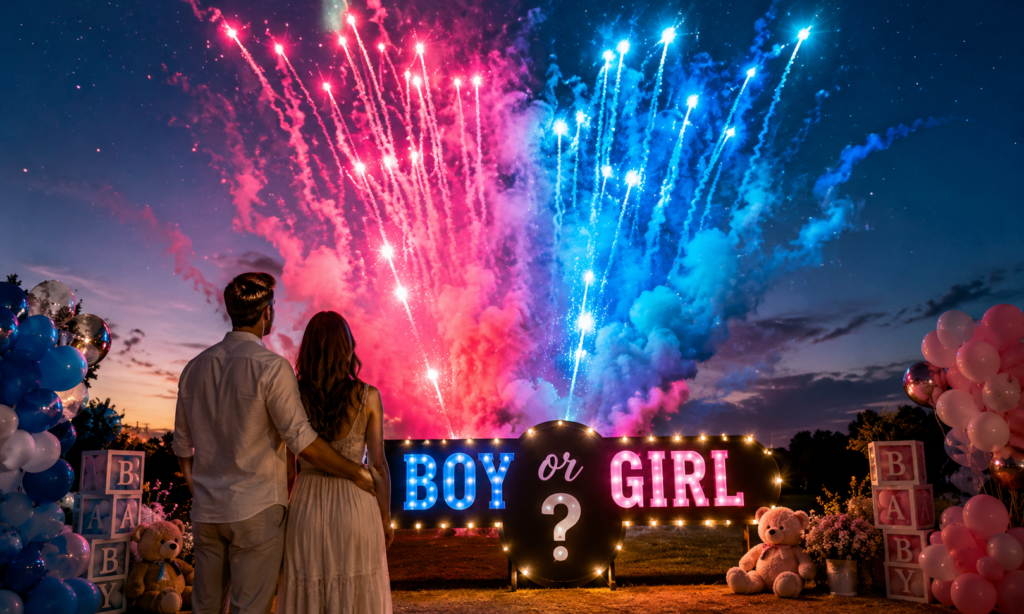

A burst of colored light across the night sky can turn a private family announcement into a highly visible event. Gender reveal fireworks have become part of that transformation, combining the traditions of celebration fireworks with the increasingly elaborate culture surrounding pregnancy announcements. But as these displays become more ambitious, communities are also confronting the practical consequences: fires, noise, debris, injuries and restrictions on pyrotechnics.
The issue is no longer simply about how parents choose to reveal whether they are expecting a boy or girl. It sits at the intersection of social-media culture, the commercial events industry, public safety and a growing debate over how much spectacle is appropriate for a private milestone.
From Simple Announcements to Elaborate Events
Gender reveal parties emerged as a recognisable social trend in the late 2000s and early 2010s. Early celebrations were often relatively simple: a cake with colored filling, a box containing balloons or an envelope opened in front of family members.
The format changed as social media made visual presentation increasingly important. Photos and videos turned a small family gathering into a shareable event, while professional photographers, event planners, and party suppliers began offering increasingly elaborate reveal options.
Among the most visually striking methods are smoke cannons, confetti, colored powder, vehicles, lighting effects and fireworks.
Fireworks have a particular appeal because they transform a reveal into a public spectacle. A single explosion can be seen and heard from considerable distances, creating an unmistakable moment for guests and cameras.
But that same visibility creates the central problem.
The bigger the display, the more it can affect people who were never invited.
Why Fireworks Became Part of Gender Reveals
Traditional fireworks have long been associated with major celebrations, including national holidays, weddings, festivals and sporting victories. Their use at gender-reveal events reflects the broader commercialisation of personal celebrations.
Several factors have helped drive the trend:
- Social media: Dramatic reveals are highly suited to short-form video.
- Event businesses: Companies increasingly package gender reveal fireworks celebrations as complete experiences.
- Photography: Fireworks create visually distinctive moments for professional photographs and video.
- Competition between celebrations: Some families seek increasingly elaborate ways to distinguish their event.
- Availability of consumer pyrotechnics: Where fireworks are legally sold to the public, they can become an accessible option.
The format also has a psychological element. A conventional cake reveal creates a moment for the people around the table. Fireworks create a moment that dominates the entire environment.
That difference helps explain both their popularity and the concern surrounding them.
The Safety Question
Fireworks are controlled explosives or pyrotechnic devices designed to produce heat, light, sound and rapidly expanding gases. Even products legally sold for consumer use can cause burns, eye injuries and fires when handled incorrectly.
The risks increase when fireworks are used outside the conditions for which they were designed.
Fire Risk
One of the most significant concerns is accidental ignition.
Dry vegetation, strong winds and nearby structures can allow a relatively small pyrotechnic incident to become a larger fire. The danger is particularly serious in regions experiencing drought or seasonal wildfire conditions.
Several highly publicised incidents have demonstrated how gender-reveal celebrations can unintentionally produce major consequences.
One of the most prominent examples occurred in California in 2020, when a pyrotechnic device used during a gender-reveal event ignited the El Dorado Fire. The blaze eventually burned thousands of acres and resulted in the death of a firefighter.
The incident became an international reference point in discussions about gender reveal fireworks celebrations and wildfire risk.
It also demonstrated an important distinction: the problem was not simply that a family wanted to celebrate. Rather, a private event introduced a fire-starting mechanism into an environment where the consequences could extend far beyond the participants.
Injuries and Property Damage
Fireworks can also malfunction, tip over or explode unexpectedly. Burns and eye injuries are among the documented hazards associated with pyrotechnics.
Property damage can occur when sparks land on roofs, vegetation, vehicles or other combustible materials.
Fire safety experts generally emphasise that legal availability does not mean a product is risk-free. Weather, surroundings, operator experience and the type of device all influence the potential consequences.
Noise Is Another Public Issue
Fire risk receives much of the attention, but fireworks also create a significant noise impact.
An explosion can disturb nearby residents, children, older adults and animals. In densely populated areas, the sound can travel well beyond the celebration site.
Some municipalities therefore regulate fireworks through restrictions on:
- Permitted dates and hours
- Types of fireworks
- Locations where fireworks may be used
- Fire-weather conditions
- Required permits
- Minimum distances from buildings or vegetation
Rules differ substantially by jurisdiction. A type of consumer firework legal in one location may be prohibited or require authorisation elsewhere.
For families planning a reveal, that legal variation matters because an event that appears private may still fall under local fire, noise, or public-event regulations.
The Environmental Cost of the Spectacle
Fireworks also leave behind physical and chemical residues.
Explosions release smoke and fine particulate matter into the atmosphere. Firework compositions can contain metals that create different colours, while paper, plastic and other components can become litter if not properly collected.
The environmental effect of a single small display is difficult to compare with larger sources of pollution. Still, repeated use across millions of celebrations and public events raises broader questions about cumulative impact.
This has encouraged some event organisers to offer alternatives such as:
- LED lighting displays
- Projection mapping
- Biodegradable confetti
- Colored smoke effects where legally permitted
- Drone or light shows
- Indoor lighting reveals
- Cake and balloon-based announcements
These options can provide visual drama without relying on explosive pyrotechnics, although each alternative has its own environmental and safety considerations.
Why Supporters Still Choose Fireworks
For supporters, fireworks are primarily a form of celebration.
They argue that families should be able to mark important milestones in ways that reflect their personalities and traditions, as long as they follow local laws and basic safety requirements.
Fireworks are also an established part of the entertainment industry. Professional pyrotechnic companies conduct displays under controlled conditions, often using trained operators, designated launch areas and safety procedures.
That distinction matters.
A professionally managed fireworks display is fundamentally different from an improvised backyard setup. The equipment, planning, weather assessment and emergency preparation can be substantially more sophisticated.
For that reason, discussions about gender-reveal fireworks often focus less on the concept itself and more on where, how and by whom the pyrotechnics are being used.
Critics Question the Escalation of Gender-Reveal Culture
Critics of increasingly elaborate gender-reveal celebrations raise a different concern: the tendency to turn a private family milestone into a large-scale spectacle.
The criticism is not necessarily directed at gender-reveal parties themselves. Instead, it centres on the escalation from modest celebrations to expensive and potentially hazardous productions.
Social media can intensify that pressure. Once spectacular reveals become widely shared, ordinary celebrations may appear less memorable by comparison.
This can create a cycle in which increasingly dramatic ideas compete for attention.
Fireworks are particularly suited to that environment because they provide an immediate visual payoff. Yet the same characteristic that makes them attractive for video can make them difficult to contain in the real world.
The Language Around “Gender Reveal” Is Also Changing
Gender reveal fireworks, Another development is the growing distinction between revealing a baby’s biological sex and announcing a child’s future gender identity.
Medical professionals and social researchers generally distinguish sex-related biological characteristics from gender, which involves identity and social experience.
As public understanding of that distinction has developed, some families have shifted toward terms such as “sex reveal,” “baby reveal,” or simply “family announcement.”
The terminology varies, and there is no single standard approach.
For many families, however, the celebration remains primarily a social tradition rather than a formal statement about a child’s future identity.
What Happens Next?
The future of gender reveal fireworks will likely depend less on the trend’s popularity and more on regulation, technology, and changing consumer expectations.
In areas vulnerable to wildfires, authorities may impose tighter restrictions on private pyrotechnics, particularly during periods of extreme fire danger.
Gender reveal fireworks, At the same time, event companies have an incentive to develop alternatives that deliver the visual impact audiences expect without using explosive devices.
The wider events industry is already familiar with this pattern. Technologies such as projection systems, programmable lighting and coordinated drones can create spectacular visuals without some of the risks associated with conventional fireworks.
That does not mean fireworks are disappearing. They remain deeply embedded in celebrations worldwide. But the circumstances in which they are considered appropriate may continue to narrow.
A Celebration With Consequences Beyond the Party
Gender reveal fireworks illustrate a larger cultural shift in how private milestones are celebrated. A pregnancy announcement that once might have involved a small group of relatives can now become a carefully produced visual event designed for hundreds or thousands of online viewers.
The attraction is easy to understand: fireworks provide an immediate, memorable and highly visual reveal.
Yet their consequences can extend beyond the people gathered at the celebration. Fire, noise, debris, injuries and environmental effects make pyrotechnics a public-safety issue as well as a party choice.
Gender reveal fireworks, As celebrations continue to evolve, the question may not be whether gender reveals will remain popular, but how far the spectacle will go—and whether future celebrations will favour explosive displays or increasingly sophisticated ways to create the same sense of occasion without the same risks.