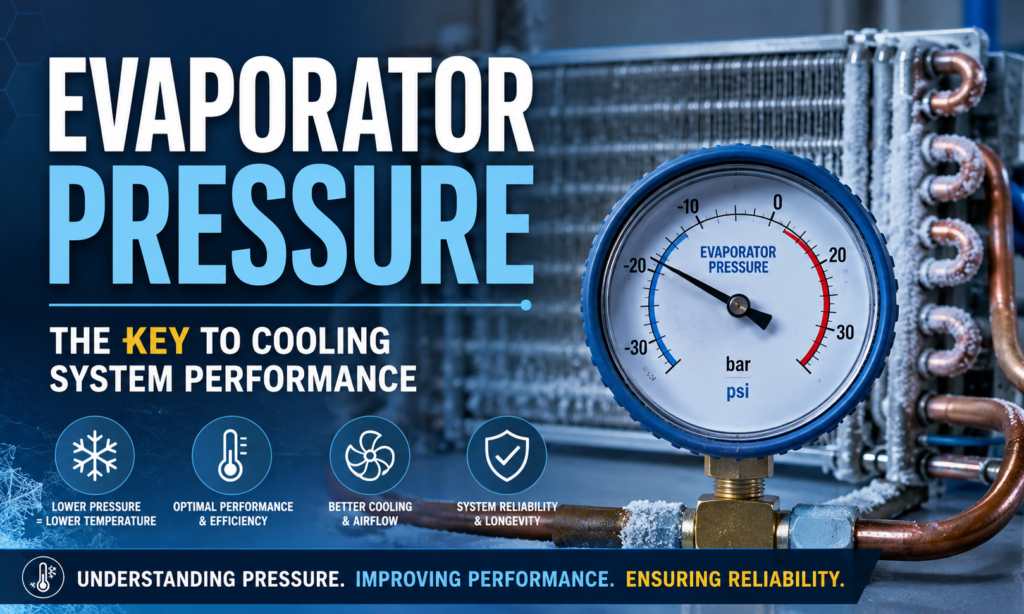

Evaporator pressure is one of the most important measurements in refrigeration and air-conditioning systems, yet it is often misunderstood outside the industry. A pressure reading inside an evaporator can reveal whether a system is operating near its intended temperature, whether refrigerant flow is balanced, and whether problems such as icing, poor cooling, or compressor stress may be developing.
At its simplest, evaporator pressure is the pressure of refrigerant as it enters or circulates through the evaporator, where the refrigerant absorbs heat from the surrounding air, water, or another medium. Because refrigerant pressure and saturation temperature are closely linked, changes in evaporator pressure can directly affect cooling performance. Understanding that relationship is essential for technicians, engineers, equipment operators, and anyone trying to interpret refrigeration-system behavior.
What Is Evaporator Pressure?
The evaporator is the part of a refrigeration system where the refrigerant absorbs heat. After passing through the expansion device, the refrigerant enters the evaporator at a much lower pressure than it had on the system’s high side.
As the refrigerant absorbs heat, it generally changes from a low-pressure liquid-vapor mixture into a vapor. The resulting vapor then travels toward the compressor.
Evaporator pressure refers to the refrigerant pressure maintained within this low-pressure section of the system.
The exact pressure depends on several variables, including:
- The type of refrigerant being used
- Desired evaporator temperature
- Indoor or process load
- Expansion-device operation
- Compressor capacity
- Condensing conditions
- Superheat and refrigerant charge
- Airflow or fluid flow across the evaporator
Therefore, no single evaporator-pressure value is correct for every refrigeration system.
Why Pressure and Temperature Are Closely Connected
One of the most important principles behind evaporator pressure is the relationship between refrigerant pressure and saturation temperature.
A refrigerant boils at a lower temperature when its pressure is reduced. This is what allows a refrigeration system to absorb heat from a relatively warm space.
For example, a refrigeration system designed to maintain a cold environment may operate with an evaporating temperature well below freezing. An air-conditioning system, by contrast, generally operates with a considerably higher evaporating temperature.
The pressure corresponding to that temperature depends on the refrigerant.
This is why technicians commonly use pressure-temperature charts or digital pressure-temperature tools. A pressure reading alone does not tell the whole story. You must also know the refrigerant type to interpret the reading correctly.
The basic sequence
The cooling process can be simplified into four stages:
- The compressor raises refrigerant pressure and temperature.
- The condenser rejects heat and condenses the refrigerant.
- The expansion device reduces refrigerant pressure.
- The evaporator absorbs heat as the refrigerant boils.
The evaporator therefore operates on the low-pressure side of the vapor-compression refrigeration cycle.
How Evaporator Pressure Influences Cooling Performance
Evaporator pressure affects the temperature at which the refrigerant evaporates. That, in turn, influences the temperature difference between the refrigerant and the medium being cooled.
A lower evaporator pressure generally corresponds to a lower saturation temperature. This can be useful when very low temperatures are required, but pushing pressure too low can create operational problems.
If evaporator pressure becomes excessively low, several consequences may appear:
- Reduced evaporating temperature
- Insufficient cooling capacity
- Increased risk of evaporator frosting or icing
- Lower refrigerant density
- Potentially greater compressor stress
- Abnormal superheat conditions
On the other hand, excessively high evaporator pressure can also be problematic. The system may fail to reach the desired temperature, while the compressor can face conditions outside its intended operating range.
The goal is therefore not simply to maximize or minimize pressure. The objective is to maintain pressure appropriate for the system’s design and cooling requirements.
What Causes Evaporator Pressure to Change?
Pressure fluctuations can have many causes. Some are normal responses to changing load, while others may indicate a fault.
Refrigerant charge
An incorrect refrigerant charge can affect evaporator behavior. Under certain conditions, insufficient refrigerant can cause low evaporator pressure, although the exact symptoms depend on the system and circumstances.
Overcharging can produce a different set of operating conditions and may raise pressures elsewhere in the system.
For that reason, pressure should not be used alone to determine refrigerant charge.
Airflow and heat load
In an air-conditioning system, the amount of air passing over the evaporator directly affects heat transfer.
If airflow falls because of a dirty filter, blocked coil, failing blower, or other restriction, the evaporator may receive less heat. This can lower evaporator temperatures and, in some systems, cause coil icing.
Conversely, a high heat load can change evaporator conditions as the system attempts to absorb more heat.
Expansion-device operation
Thermostatic expansion valves, electronic expansion valves, and other metering devices regulate refrigerant entering the evaporator.
If the device is incorrectly adjusted, obstructed, improperly controlled, or operating under unusual conditions, it can affect evaporator pressure and superheat.
Compressor capacity
The compressor removes vapor from the evaporator. If compressor capacity changes, suction-side pressure can change as well.
Modern systems may use variable-speed compressors that continuously adjust capacity according to demand. This makes evaporator pressure a dynamic operating variable rather than a permanently fixed number.
Evaporator Pressure and Superheat
Pressure becomes particularly useful when considered alongside superheat.
Superheat is the temperature of refrigerant vapor above its saturation temperature at a given pressure.
Technicians can measure suction pressure, convert it to a saturation temperature for the particular refrigerant, and compare it with the actual refrigerant temperature.
The difference indicates superheat.
This measurement helps technicians determine whether the refrigerant is properly evaporating before it reaches the compressor.
Too little superheat can risk liquid refrigerant returning to the compressor, while excessive superheat may indicate insufficient refrigerant flow or other operating problems.
The correct target, however, varies according to equipment design and operating conditions.
Common Symptoms of Abnormal Evaporator Pressure
A pressure problem rarely appears in isolation. Technicians typically examine several measurements and physical symptoms together.
Potential warning signs can include:
- Unusually low suction pressure
- Unusually high suction pressure
- Poor cooling performance
- Evaporator icing
- Abnormal compressor temperature
- Excessive or insufficient superheat
- Unusual temperature differences across the evaporator
- Reduced system efficiency
- Frequent cycling or unstable operation
These symptoms can have multiple causes, so diagnosing the system requires more than simply comparing a pressure gauge with a generic chart.
A Look at Different Refrigeration Applications
Evaporator pressure varies substantially depending on what a system is designed to do.
Comfort air conditioning
Air-conditioning systems generally operate at evaporating temperatures that cool indoor air without continuously freezing the evaporator coil.
Maintaining stable evaporator conditions helps provide consistent comfort while protecting system components.
Commercial refrigeration
Refrigerated display cases, food-storage systems, and other commercial applications can require substantially different evaporating conditions.
A system designed for chilled products may operate at a higher evaporating temperature than one designed for frozen storage.
Industrial refrigeration
Industrial systems can involve very low temperatures, large heat loads, and complex control arrangements.
In these applications, evaporator pressure may be closely monitored as part of automated control systems. Changes can affect production processes and energy consumption.
Why Low Pressure Does Not Automatically Mean a Refrigerant Leak
One common misconception is that low evaporator pressure always indicates low refrigerant charge.
A refrigerant shortage is one possible explanation, but it is not the only one.
Low suction pressure may also be associated with:
- Restricted refrigerant flow
- Low heat load
- Poor airflow
- Frost buildup
- Incorrect expansion-device operation
- Compressor-related conditions
- Ambient or operating changes
This is why experienced technicians generally consider pressure readings alongside temperature measurements, superheat, subcooling, airflow, system history, and manufacturer specifications.
The Role of Modern Controls
Refrigeration technology has increasingly moved toward electronic monitoring and variable-capacity operation.
Sensors can continuously monitor pressure and temperature, while controllers adjust compressors, fans, and expansion devices in response to changing conditions.
This approach can improve temperature stability and potentially reduce unnecessary energy consumption.
Variable-speed technology also changes the traditional idea of a refrigeration system operating at one fixed pressure. Instead, the system may continuously adjust its operating point according to load.
That makes accurate sensing and control increasingly important.
Energy Efficiency and Evaporator Pressure
Evaporator pressure also affects energy consumption.
In many refrigeration applications, operating at a higher evaporating temperature—when the cooling requirement permits it—can reduce the work required by the compressor.
However, increasing evaporator pressure beyond the system’s appropriate operating range can compromise the required product or space temperature.
The challenge is therefore finding an operating condition that balances:
- Required cooling temperature
- Compressor energy use
- Heat-transfer performance
- Equipment reliability
- Refrigerant behavior
- Control stability
Modern system design increasingly treats these factors as interconnected rather than independent.
What Happens Next?
The importance of evaporator pressure is unlikely to diminish as refrigeration systems become more sophisticated.
Future equipment is expected to use electronic expansion valves, variable-speed compressors, sensors, automated diagnostics, and connected monitoring systems more widely.
These technologies could make it easier to identify abnormal pressure conditions before they develop into major equipment failures.
At the same time, refrigerant transitions and changing environmental requirements are introducing new operating characteristics for equipment designers and technicians. Different refrigerants can have different pressure-temperature relationships, so established diagnostic habits may not transfer directly from one system to another.
Conclusion
Evaporator pressure may seem like just another number on a refrigeration gauge, but it tells a much bigger story about how a cooling system is operating.
It is connected to refrigerant temperature, heat absorption, compressor behavior, expansion control, efficiency, and system reliability. A pressure reading becomes especially meaningful when combined with temperature, superheat, airflow, and the manufacturer’s operating specifications.
As refrigeration technology moves toward more intelligent controls and variable-capacity systems, understanding evaporator pressure will remain fundamental. The bigger question is not simply what pressure a system should have, but how that pressure fits into the equipment’s overall thermodynamic and mechanical picture.
May you also like: Who Is Rebecca Dunn? A Look at Her Philanthropy, Public Work and Influence