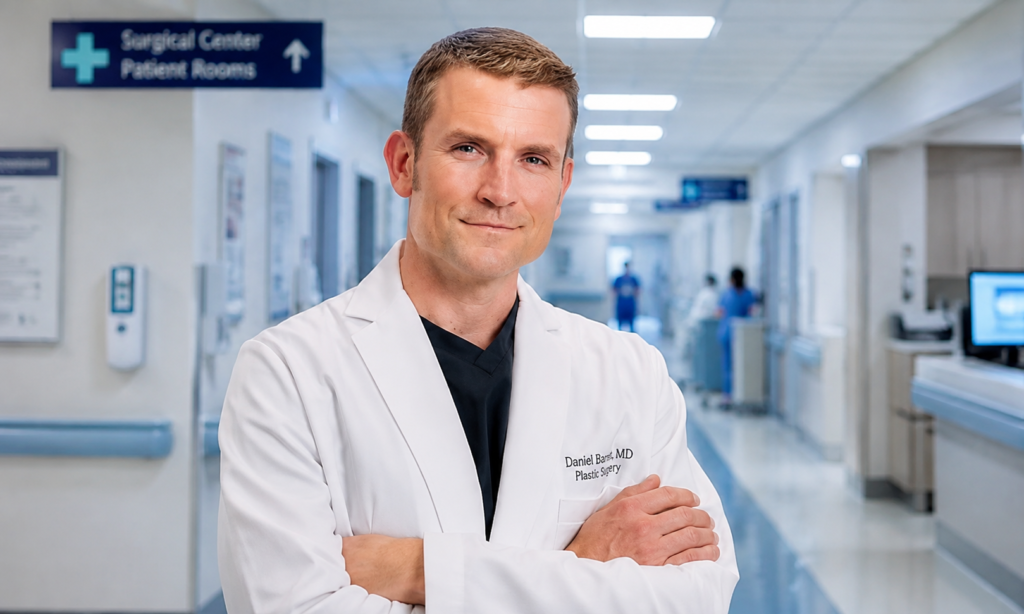

Dr Daniel Barrett has built his professional identity at the intersection of medicine, cosmetic surgery, and digital media. Based in Beverly Hills, California, the plastic surgeon has developed a practice focused on breast and body procedures while also becoming widely recognised for educational and commentary-driven content online. His growing public profile reflects a broader change in how patients discover doctors and learn about cosmetic procedures.
From Plastic Surgery Training to Beverly Hills
Barrett’s career began with extensive training in plastic and reconstructive surgery. Originally from Virginia, he eventually moved to Los Angeles, where he completed his training in plastic and reconstructive surgery at the University of Southern California.
That background is important because modern plastic surgery extends well beyond elective cosmetic procedures. Training in the speciality can involve reconstructive work related to trauma, burns, congenital conditions, and other complex medical circumstances.
Barrett has emphasised this broader foundation in public discussions of the profession. His approach reflects a speciality that combines medical reconstruction with aesthetic surgery.
He later established his practice in Beverly Hills, one of the world’s most recognisable centres for cosmetic medicine. Over time, his practice expanded around aesthetic procedures involving the breast, abdomen, body contouring, and fat transfer.
What Dr. Daniel Barrett Is Known For
Dr Daniel Barrett’s professional identity is closely tied to achieving cosmetic results that look natural and proportionate.
His public-facing materials emphasizeemphasize individualizedindividualized procedures, attention to body proportions, recovery, and surgical techniques tailored to the individual patient rather than a single standardizedstandardized approach.
Breast and Body Procedures
A significant part of Barrett’s practice involves breast and body surgery.
His work includes traditional breast augmentation, breast procedures involving implants, and fat-transfer techniques. Body-focused procedures include tummy tucks, liposuction, Brazilian butt lifts, and combinations of procedures commonly associated with post-pregnancy body transformation.
The philosophy behind these procedures has changed considerably over the years. Earlier cosmetic-surgery marketing often emphasised dramatic transformations, while contemporary discussions increasingly focus on proportion, recovery, patient anatomy, and results that complement the individual’s existing features.
Barrett’s public profile has largely followed this shift.
The Social-Media Doctor
One of the most significant developments in Barrett’s career has occurred outside the operating room.
He has developed a substantial presence on social-media platforms, particularly through short-form videos discussing plastic surgery, cosmetic trends, recovery, and changes in appearance.
This represents a major shift in how medical professionals communicate with potential patients.
Traditionally, people might have discovered a surgeon through personal referrals, advertisements, medical directories, or consultations. Social media has created another pathway: short videos that answer common questions and introduce viewers to medical procedures before they ever visit a clinic.
For physicians, the advantage is considerable. Educational content can reach a large audience without requiring viewers to make an appointment first.
The challenge is that social media also compresses complicated medical subjects into very short formats.
Celebrity Analysis Became Part of His Public Image
Dr Daniel Barrett has also drawn attention for discussing possible cosmetic procedures among celebrities.
His public commentary has included discussions involving well-known entertainers and public figures whose appearances have generated speculation about cosmetic surgery.
These discussions generally involve assessments of publicly available photographs rather than direct medical examinations.
That distinction is important.
When a surgeon evaluates photographs, the conclusions are necessarily limited. Lighting, makeup, camera angles, ageing, changes in weight, facial expressions, and photography techniques can all influence someone’s appearance.
For that reason, a visual assessment cannot establish a person’s medical history with certainty.
This is particularly relevant when discussing celebrities who have not publicly confirmed whether they have undergone a particular procedure.
Why Celebrity Surgery Has Become a Public Conversation
The growing discussion around cosmetic surgery reflects a broader cultural shift.
Social media has made celebrity images available constantly and on an enormous scale. At the same time, cosmetic procedures have become more openly discussed in mainstream culture.
People can now encounter information about:
- Breast augmentation
- Liposuction
- Rhinoplasty
- Facelifts
- Eyelid surgery
- Fillers
- Botox
- Fat transfer
- Skin treatments
The result is a more visible conversation about procedures that were once discussed primarily in private.
Doctors with large online audiences have consequently become part of the public conversation surrounding beauty standards and cosmetic medicine.
Dr Daniel Barrett’s commentary fits into this wider trend by attempting to explain what viewers may or may not be seeing in photographs and videos.
The Influence of Social Media on Patient Expectations
One of the more complicated issues surrounding cosmetic surgery is the difference between online images and real-world results.
Photographs and videos can be edited, carefully lit, filtered, posed, or selected from a much larger collection. Even without digital editing, a person’s appearance can change significantly depending on the camera angle or lighting.
This can shape how potential patients view cosmetic procedures.
A person may see a celebrity or influencer and assume they can reproduce a particular appearance through one procedure. In reality, surgical outcomes depend on anatomy, age, skin quality, medical history, lifestyle, and numerous other factors.
This is why medical consultation remains an important part of the process.
A social-media video can provide general information, but it cannot replace an individualised examination.
A Growing Business and Professional Footprint
Dr Daniel Barrett’s professional development has also involved expansion beyond individual procedures.
His practice has developed multiple areas associated with breast surgery, body contouring, tummy tucks, recovery, and other aesthetic services.
The broader trend reflects how cosmetic medicine has evolved into a complex healthcare and business sector.
A modern cosmetic practice may involve:
- Surgical procedures
- Consultation services
- Recovery programs
- Non-surgical aesthetic treatments
- Patient education
- Social-media communication
- Postoperative support
For surgeons with significant public visibility, these elements can become closely connected.
A social-media audience may introduce someone to a surgeon, educational content may shape their understanding of a procedure, and a subsequent consultation may determine whether surgery is appropriate.
Recognition in the Plastic-Surgery Field
Dr Daniel has also received recognition through professional and media-based listings.
His public profile has included recognition associated with national plastic-surgery rankings and professional coverage.
Such distinctions can contribute to a surgeon’s visibility, but rankings should be understood within their specific methodology. Recognition on a list does not guarantee a particular result for every patient.
Surgical outcomes can vary according to the procedure, the individual’s anatomy and health, the surgical plan, postoperative care, and other circumstances.
For patients researching cosmetic surgery, professional credentials and board certification are generally only part of what they should consider.
The Debate Around Medical Advice on Social Media
Dr Daniel’s career also illustrates a broader debate affecting doctors who build large online audiences.
Social media can make medical information easier to understand and more accessible. A short explanation of a procedure may help someone learn basic terminology and prepare questions for a consultation.
However, there are clear limitations.
A short video cannot replace a physical examination, a detailed medical history, informed consent, or an individualizedindividualized discussion of risks and benefits.
Cosmetic surgery also involves potential complications, and those risks vary by procedure and individual patient.
This creates a balancing act for physician creators: provide useful general education while making clear that online information is not a personalised medical assessment.
What Could Come Next?
The next phase of Dr Daniel Barrett’s career is likely to involve both clinical practice and digital communication.
His continued presence online provides a platform to discuss cosmetic procedures, recovery, aesthetic trends, and questions patients commonly encounter.
At the same time, the cosmetic-surgery industry continues to change as patients seek increasingly individualizedindividualized treatments.
Technological developments, less-invasive procedures, improved surgical techniques, and changing attitudes toward cosmetic enhancement will likely influence the field in the coming years.
For surgeons with large digital audiences, education may become increasingly important alongside traditional medical practice.
The Bigger Picture
Dr Daniel Barrett’s career illustrates how dramatically the public role of a plastic surgeon has changed.
He is known not only for his work in the operating room. His public profile now encompasses cosmetic surgery, patient education, social media, celebrity appearance analysis, and the business side of modern aesthetic medicine.
His career also reflects a broader transformation in healthcare communication. Patients increasingly encounter doctors online before they ever enter a consultation room, while physicians have unprecedented opportunities to explain their specialities directly to large audiences.
The challenge is maintaining a clear distinction between general education and individualised medical advice.
As cosmetic surgery becomes more visible in mainstream culture, the role of doctors like Dr Daniel may increasingly extend beyond performing procedures. The larger question is how physicians, patients, and social-media platforms will balance accessibility, education, expectations, and medical responsibility in an increasingly image-driven culture.