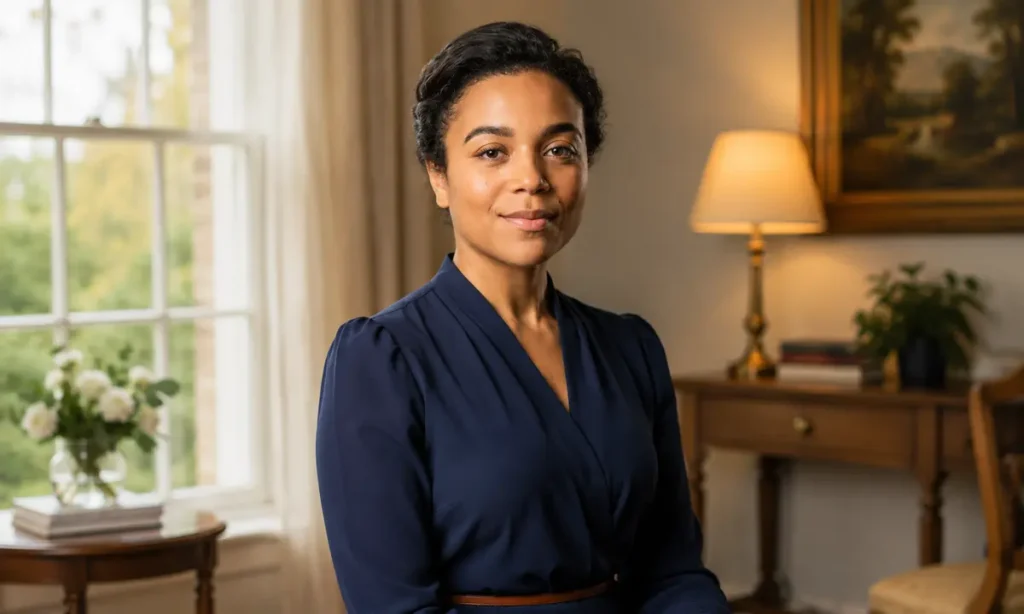

When Nurse Anderson Lucille arrived at Nonnatus House, she represented more than a new face in Call the Midwife. Her arrival placed Caribbean women’s experiences at the centre of a drama about 1960s Britain. Through Lucille, the series explored migration, professional ambition, racism, marriage and belonging while connecting a fictional character to the real history of West Indian nurses who came to Britain to work for the NHS.
Why Lucille Anderson Matters
Lucille Anderson is a fictional nurse in the BBC period drama Call the Midwife, played by British actress Leonie Elliott. She first appeared in Season 7, which premiered in 2018, and was introduced as the show’s first regular West Indian Midwife. BBC and PBS materials describe her as a nurse recruited from Jamaica, while the character’s story is rooted in the experiences of Caribbean women who came to Britain during the 1960s.
That distinction is important. Lucille Anderson is not presented as a documentary recreation of one identifiable historical nurse. Instead, her story functions as a dramatic representation of a broader generation of Caribbean healthcare workers.
Her character gives viewers a way to understand a period when Britain urgently needed medical staff while many Caribbean migrants encountered prejudice and discrimination despite their professional qualifications.
From Jamaica to Britain
According to the official PBS character biography, Lucille was born in Mandeville, Jamaica, in 1940. She initially worked as a librarian before travelling to England in 1960 to train as a nurse. The character came from a relatively comfortable middle-class family, with her father working as a teacher and her mother managing a large household.
Her decision to leave Jamaica is central to understanding the character.
Anderson Lucille is not portrayed simply as someone searching for economic opportunity. She is ambitious, educated and determined to build a professional life. Nursing becomes a route through which she can challenge the limited opportunities available to Black women in Britain at the time.
The character biography also places her journey within the wider recruitment of Caribbean workers into the NHS. Britain faced serious shortages in healthcare staff after the Second World War, creating demand for workers from across the Commonwealth.
The historical background
The arrival of Caribbean nurses was part of a much larger movement of people from Britain’s former colonies and Commonwealth countries.
The Windrush generation is often associated with transportation, factory work and public services, but healthcare was another important area of employment. Caribbean nurses and other medical workers became part of Britain’s health system during a period when hospitals and nursing services needed additional staff.
Call the Midwife creator Heidi Thomas has said that the show’s seventh season was set during a period when a large wave of Caribbean women arrived in Britain to work in nursing, while also facing an often unwelcoming environment.
Anderson Lucille’s story therefore connects an individual character to a major postwar transformation in British society.
A New Kind of Character for Call the Midwife
Lucille’s introduction was significant within the history of the series itself.
PBS and BBC publicity described her as the first West Indian Midwife to become a regular character in Call the Midwife. The producers deliberately used her arrival to broaden the show’s portrayal of 1960s Britain.
Before Lucille, the series had already dealt with poverty, class, women’s rights, disability, changing attitudes toward sexuality and medical developments. Her character added another dimension: the experiences of Black Caribbean professionals working inside institutions that were still shaped by racial prejudice.
That allowed the drama to examine racism without reducing Lucille to a victim.
Anderson Lucille is shown as competent, disciplined and compassionate. At the same time, she has frustrations, ambitions and vulnerabilities that make her more than a symbol of migration.
Racism and Professional Identity
One of the most important elements of Lucille’s storyline is the tension between her professional qualifications and the assumptions made about her because of her race.
PBS notes that some residents of Poplar question her abilities because of her West Indian background.
This conflict reflects a broader historical contradiction.
Britain actively needed nurses, yet Black and Caribbean professionals could still encounter prejudice in workplaces and communities. Their qualifications did not necessarily protect them from discriminatory attitudes.
For Lucille, nursing becomes both a career and a test of belonging.
She is expected to provide the same level of care as her colleagues while sometimes having to overcome assumptions that white nurses may not face.
Why this storyline resonates
The effectiveness of Anderson Lucille’s story comes partly from its restraint.
Rather than making every storyline about race, the series allows discrimination to exist alongside ordinary professional and personal experiences. Lucille treats patients, develops friendships, builds relationships and confronts everyday problems.
That approach gives the character a more complete identity.
Leonie Elliott has also discussed the personal connection she felt with the role. In an interview with Radio Times, Elliott explained that her own family connections to Jamaica created an immediate sense of familiarity with Lucille’s background.
Lucille and Cyril: A Story About Belonging
Lucille’s personal life becomes another important part of her development.
Her relationship with Cyril Robinson, played by Zephryn Taitte, offers the series an opportunity to explore the experiences of Caribbean migrants beyond the workplace.
Their relationship is not isolated from the realities around them.
Housing, prejudice and financial pressures become part of their story. PBS episode material, for example, describes Cyril’s concerns after his rooming house is condemned and his pessimism about finding somewhere new amid prejudice in the East End.
Their relationship consequently becomes more than a conventional television romance.
It reflects the practical challenges facing people attempting to build stable lives in a society where they were often treated as outsiders.
The Character’s Professional Development
Anderson Lucille’s professional journey also evolves throughout the series.
She begins as an experienced nurse entering a new environment but continues to face challenges that test her confidence and adaptability. Her work allows the drama to show different aspects of healthcare, from home visits and childbirth to hospital assignments.
The BBC Programme Index confirms Lucille’s continuing presence in later episodes, identifying Leonie Elliott as Nurse Lucille Anderson in Season 8.
This continuity matters because it prevents the character from becoming a one-season historical reference.
Instead, Lucille becomes part of the larger community at Nonnatus House.
Her colleagues gradually become friends and allies, while her personal relationships develop alongside her career.
Leonie Elliott’s Role in Bringing Lucille to Life
Much of Lucille’s impact depends on Elliott’s performance.
Before joining Call the Midwife, Elliott had appeared in productions including Black Mirror, Casualty, Wondrous Oblivion and Danny and the Human Zoo. Radio Times reported that Elliott became associated with the role as the actress behind the show’s first regular West Indian Midwife.
Her portrayal emphasises Lucille’s quiet determination rather than relying on constant dramatic confrontation.
That choice helps explain why the character became memorable.
Lucille can be firm without being aggressive, vulnerable without becoming helpless and ambitious without losing empathy for the people she treats.
The Wider NHS Connection
Anderson Lucille’s fictional career also points toward a genuine chapter in NHS history.
The postwar health service depended heavily on overseas recruitment. Caribbean nurses were among the professionals who responded to Britain’s need for medical workers.
Their contribution was particularly important because nursing required specialised training and sustained professional commitment.
Yet the history of migration into the NHS was not simply a story of opportunity.
Healthcare workers arriving from the Caribbean could encounter discrimination, unequal treatment and social prejudice. Call the Midwife uses Lucille’s experiences to bring those contradictions into a personal narrative.
A broader lesson from the character
Anderson Lucille’s story demonstrates how historical drama can connect institutional history with individual experience.
Statistics can show migration patterns and workforce shortages, but a character can illustrate what those changes meant for a person trying to establish a career, a home, and a family.
That is one reason Lucille has remained an important part of the show’s historical storytelling.
What Lucille Anderson Represents Today
Although Lucille’s main story is set in the early 1960s, the questions surrounding her character remain relevant.
Her story touches on several enduring issues:
- Migration: How professionals adapt when they move to another country.
- Workforce shortages: How national institutions can become dependent on international recruitment.
- Racism: How prejudice can affect people even when they possess valuable skills and qualifications.
- Representation: How television can introduce audiences to overlooked historical experiences.
- Belonging: How immigrants create communities and identities in unfamiliar environments.
The significance of Lucille therefore extends beyond Call the Midwife.
And Anderson Lucille represents a generation whose contributions to British public services have increasingly become part of the country’s wider historical conversation.
What Comes Next for Lucille’s Legacy?
Lucille Anderson’s importance is unlikely to depend on whether audiences remember every detail of her fictional biography.
Lucille Anderson’s lasting value comes from what the character makes visible.
Through Lucille, Call the Midwife connects the intimate world of childbirth and nursing with the larger forces of postwar migration and social change. Her presence also reminds viewers that Britain’s NHS was shaped not only by doctors, nurses and institutions born in Britain, but also by professionals who travelled thousands of miles to serve within it.
The character’s story has already become part of the show’s wider legacy. PBS continues to feature Lucille in its character and episode material, while BBC records document her presence across multiple seasons.
Conclusion
Anderson Lucille, better known as Nurse Lucille Anderson in Call the Midwife, occupies a distinctive place in modern television’s portrayal of Britain’s postwar history. She is fictional, but the world surrounding her is grounded in real social developments: Caribbean migration, NHS recruitment, racial discrimination and the struggle for professional recognition.
Her story works because it combines the personal with the historical.
Lucille Anderson is not simply a representation of Caribbean nurses. She is portrayed as a woman with ambitions, relationships, doubts and professional pride who happens to be living through a major period of social change.
That may ultimately be the character’s greatest significance. By giving one fictional nurse a detailed life, Call the Midwife helps make a much larger historical story easier to see—and leaves an enduring question about how Britain’s healthcare system remembers the people who helped build it.