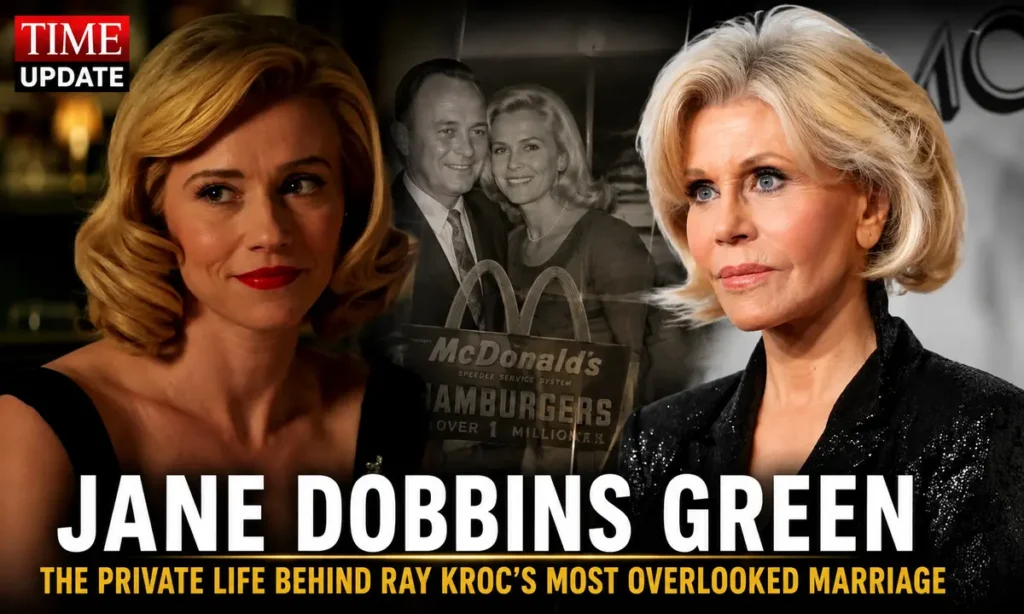

Jane Dobbins Green rarely appears in the headlines that define McDonald’s history. Her name, however, sits quietly inside the personal story of Ray Kroc, the businessman whose aggressive expansion strategy helped turn McDonald’s into a global restaurant company. Their marriage lasted only from 1963 to 1968, yet it coincided with a crucial period in Kroc’s rise.
What makes Green’s story particularly interesting is not simply her connection to Kroc, but how little of her own life survives in the public record. Unlike Kroc and his third wife, Joan, Green largely stayed out of public life. Reconstructing her biography therefore requires separating documented history from details repeatedly copied online without strong supporting evidence.
A Woman Whose Biography Became Entangled With a Business Legend
Jane Elizabeth Dobbins was born in Walla Walla, Washington, in 1911. Historical research identifies her parents as David and Grace Duncan Dobbins.
Beyond those basic facts, comparatively little is firmly established about her childhood or education. Numerous modern websites provide precise dates, family details, and accounts of her early years, but much of that material comes from secondary or genealogical sources rather than substantial primary documentation.
That distinction matters because Green’s life has increasingly been reconstructed through articles about Ray Kroc rather than through records she produced herself.
One of the best-documented details of her early professional life is her work as John Wayne’s secretary. Kroc himself referred to her occupation in his 1977 autobiography, Grinding It Out: The Making of McDonald’s.
She therefore had a professional identity before becoming associated with one of America’s most recognizable business people.
Her Hollywood Connection
Green’s work for Wayne has sometimes been expanded in online biographies into descriptions suggesting a much broader Hollywood career. The available evidence does not establish that she was an actress, producer, or entertainment executive.
The more defensible description is straightforward: she worked as a secretary for John Wayne.
That detail places her within the professional world of mid-century Hollywood without turning her into a celebrity herself.
How Jane Dobbins Green Met Ray Kroc
Green entered Ray Kroc’s life at a pivotal moment.
Kroc had already divorced his first wife, Ethel Fleming, in 1961. By then, his relationship with the McDonald brothers had developed into something much larger than the original restaurant arrangement.
Kroc had helped develop the McDonald’s franchise system during the 1950s. In 1961, he acquired the rights associated with the McDonald brothers’ business, setting the stage for the company’s continued expansion under his control.
According to Kroc’s own memoir, a mutual friend introduced him to Jane. He recalled being attracted to her personality and described a remarkably rapid courtship.
The two had dinner on consecutive evenings before marrying roughly two weeks after meeting. They married on 23 February 1963.
The speed of the relationship is one of the better-documented features of their story, largely because Kroc himself wrote about it.
But one important limitation remains: most surviving accounts describe the relationship from Kroc’s perspective. Jane left no comparable widely available memoir explaining what she thought about the courtship or marriage.
That imbalance characterizes her entire biography.
Marriage During McDonald’s Expansion
Green married Kroc as McDonald’s moved rapidly beyond its earlier American footprint.
Kroc had become increasingly influential in the company during the 1950s, and the franchising system was expanding throughout the United States. By the early 1960s, his relationship with the original McDonald brothers had deteriorated, and Kroc eventually gained greater control of the business.
Green was Kroc’s wife during the company’s major transformation.
That does not, however, mean she was an executive at McDonald’s.
No reliable evidence establishes Green as a corporate decision-maker, franchise strategist, or senior company employee. Her historical significance is largely personal: she married Kroc during an important phase of the company’s development.
By the end of the 1960s, McDonald’s had grown dramatically, with thousands of restaurants operating across the United States and the company’s franchise model becoming one of the most influential business systems in the restaurant industry.
5. Kroc’s business strategy and the company’s franchise infrastructure, rather than Green’s public role, largely drove the expansion.
The Jane Green–Joan Kroc Confusion
One of the biggest problems in researching Jane Dobbins Green is the frequent confusion between her and Joan Kroc, Kroc’s third wife.
They were different women who entered Kroc’s life at different times.
Joan, born Joan Smith, was the musician Kroc encountered while visiting a restaurant in St. Paul. Their relationship eventually developed into marriage after Kroc’s relationship with Jane had ended.
Jane, by contrast, was the former John Wayne secretary whom Kroc met through a mutual acquaintance and married in 1963.
The distinction is more than a biographical footnote. Joan later became widely known for her philanthropy, particularly following Ray Kroc’s death in 1984. Those charitable activities are sometimes mistakenly folded into accounts of Jane’s life.
They should not be.
Two Very Different Public Profiles
Jane Dobbins Green Joan Kroc
Kroc’s second wife Kroc’s third wife
Married Kroc in 1963 Married Kroc in 1969
Previously worked as John Wayne’s secretary Known for her musical background.
Divorced Kroc in 1968 Remained married to Kroc until his death
Largely private Became a major philanthropic figure
The comparison helps explain why Green is considerably less visible in the historical record.
What Happened After the Divorce?
Green and Kroc divorced in 1968 after approximately five years of marriage.
Her life afterward is considerably harder to reconstruct.
Some genealogical and modern biographical sources report that she later used the surname Whitney and died in 2000. Other sources disagree about precise dates and aspects of her later personal history.
That uncertainty is worth emphasizing rather than filling with speculation.
No substantial public record suggests that Green sought to capitalize on her association with Kroc. She did not become a major media personality, publish a widely known memoir, or develop the kind of highly visible public profile that would have generated extensive documentation.
As a result, the later decades of her life remain comparatively obscure.
Family, Children and Personal Life
Historical research identifies Green’s parents as David and Grace Dobbins.
Sources also indicate that she had experienced several marriages before meeting Kroc, although the exact chronology and details of those relationships are not consistently documented across available biographical sources.
Claims about children, education, and later family relationships also vary among modern biographies.
No well-established public record shows that Jane Dobbins Green and Ray Kroc had children together.
Kroc’s documented daughter, Marilyn Kroc Barg, was from his first marriage to Ethel Fleming.
This is another area where separating documented record from assumptions matters.
Why Her Story Still Matters
At first glance, Jane Dobbins Green might seem like a minor figure in McDonald’s history. She never ran the company and never became a public business leader.
But her story illustrates something broader about how history is recorded.
Public attention tends to preserve the lives of people who built companies, appeared in newspapers, gave interviews, or deliberately cultivated public identities. People who lived close to major historical figures without becoming public figures themselves can disappear from the record surprisingly quickly.
Green’s biography demonstrates that problem.
Her life intersected with Hollywood through John Wayne, with American business history through Ray Kroc and with one of the most dramatic periods of McDonald’s expansion. Yet most of what readers encounter today is information about her in relation to other people, rather than a detailed account of her own ambitions, opinions, or experiences.
That makes restraint especially important.
A lack of evidence is not evidence of a dramatic hidden story. Sometimes it simply means the historical record is incomplete.
The Unanswered Questions
Several aspects of Green’s life remain difficult to establish with confidence:
- Her detailed childhood and education are not well documented.
- Her complete employment history before Kroc remains unclear.
- Her perspective on her marriage to Kroc is largely absent from the public record.
- The precise details of her later relationships are inconsistently reported.
- Public estimates of her personal wealth or “net worth” lack a reliable evidentiary basis.
- Treat claims about exact dates in her later life cautiously unless primary records support them.
In an era when biographical websites often repeat the same information, those gaps matter.
Repeating a claim across dozens of websites does not necessarily make the underlying claim more reliable. In Green’s case, the distinction between documented facts and repeated internet biography matters.
Looking Back at Jane Dobbins Green
Jane Dobbins Green‘s place in American history is unusual.
She was neither the architect of McDonald’s expansion nor a celebrity in her own right. Yet, her five-year marriage to Ray Kroc places her alongside one of the defining business transformations of the 20th century.
Her earlier work as John Wayne’s secretary provides an independent chapter. At the same time, her marriage to Kroc connects her to the years when McDonald’s was becoming a national—and eventually international—powerhouse.
What remains most striking is the contrast between the scale of the world surrounding Green and the quietness of her own historical footprint.
Ray Kroc’s legacy can be measured in restaurants, franchises, corporate records, and decades of biographies. Jane’s legacy is much harder to quantify. Her story survives primarily through the recollections and histories of people around her.
Perhaps the most useful way to understand Jane Dobbins Green today is not as a forgotten architect of McDonald’s, nor as an invented mystery figure, but as a private woman whose life briefly intersected with Hollywood and one of America’s most consequential business stories.
The unanswered question is how much more of her own story might emerge if future archival or genealogical research brings her perspective into clearer focus.