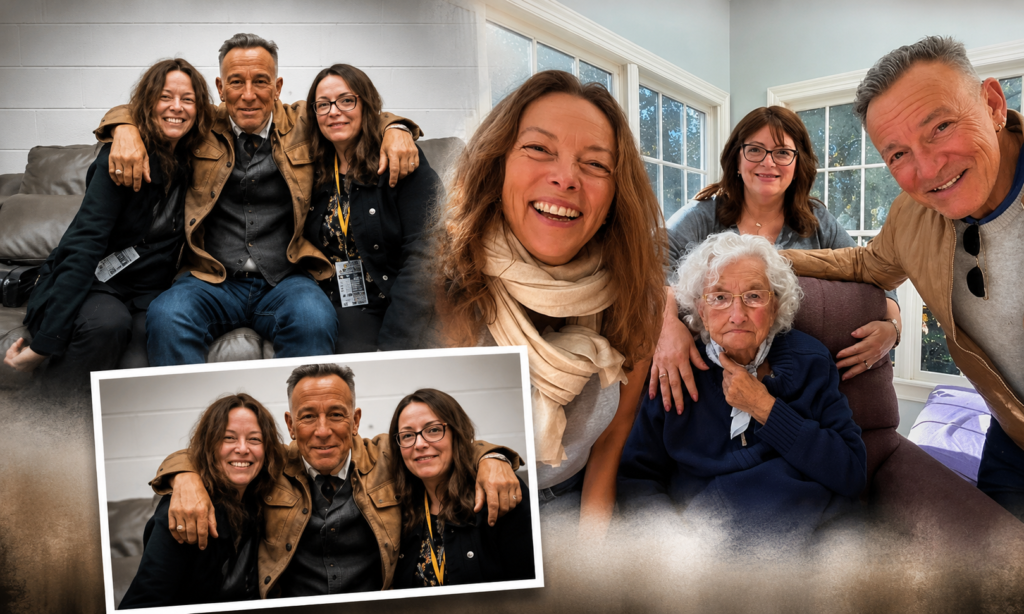

The name Virginia Springsteen Shave has recently drawn renewed attention, but not because she sought a career in entertainment. Instead, her story is tied to one of Bruce Springsteen’s most personal songs, “The River.” Virginia, Bruce’s younger sister, lived through a teenage pregnancy, early marriage, and the economic pressures of young adulthood in New Jersey. Her experience later became part of the emotional foundation for a song that has remained central to Springsteen’s musical legacy.
For readers who encounter the phrase “Virginia Springsteen Shave” in searches today, one point matters: “Shave” is her married surname, not a reference to shaving or grooming. Virginia Springsteen was born into the same New Jersey family that produced Bruce Springsteen, but unlike her famous brother, she largely stayed out of public life. Her story became known because Bruce transformed elements of her experience with Michael “Mickey” Shave into “The River,” released in 1980.
Who Is Virginia Springsteen Shave?
Virginia Springsteen Shave is Bruce Springsteen’s younger sister and the older sister of photographer and former actress Pamela Springsteen.
She grew up in Freehold, New Jersey, in a working-class family headed by Douglas and Adele Springsteen. Bruce, born in 1949, was Virginia’s older brother, while Pamela was born considerably later. People have described Virginia as the more private of Bruce’s two sisters.
Virginia did not pursue the celebrity career her brother pursued. Instead, much of her adult life centered on marriage and family.
That difference is part of what makes her story unusual. She became connected to popular culture not through a public career of her own, but through the way a family experience was transformed into music.
Growing Up in the Springsteen Family
The Springsteen household became an important source of Bruce’s later songwriting.
Their mother, Adele, worked as a legal secretary, while their father, Douglas, held a succession of blue-collar jobs. Accounts of Bruce’s childhood frequently describe a modest New Jersey upbringing in which work, family responsibility, and financial limitations were part of everyday life. Vanity Fair’s profile of Bruce noted that Douglas moved between blue-collar jobs, while Adele provided important stability within the family.
Those circumstances would eventually become central themes in Bruce’s music.
Rather than writing only about musicians or extraordinary lives, Springsteen repeatedly focused on workers, young couples, family pressures, and people trying to maintain dignity amid economic uncertainty.
Virginia’s experience fit naturally into that creative world.
The Teenage Pregnancy and Early Marriage
The key episode in Virginia’s public story occurred while she was still in high school.
Sources describing the Springsteen family biography say Virginia became pregnant during her senior year and subsequently married her boyfriend, Michael “Mickey” Shave. People reports that Virginia was 18 when she became pregnant, while other accounts give slightly different ages. The precise details vary by source, but the broader outline is consistent: she entered marriage and motherhood at a young age.
Mickey later worked in construction to help support the growing family.
For Virginia, these were not abstract themes. They involved the practical realities of earning money, raising children, and building a household while still very young.
For Bruce, meanwhile, his sister’s experience became material he could examine through songwriting.
How Virginia’s Story Became “The River”
“The River” emerged in the late 1970s and was eventually released as the title track of Bruce Springsteen’s 1980 double album.
The song follows a young couple whose early relationship changes after an unexpected pregnancy. Marriage and work follow, but economic hardship gradually challenges their expectations for the future.
Although the song is not a literal transcript of Virginia’s life, it grew out of her experience with Mickey.
Springsteen later discussed the connection publicly. During a 2021 appearance on The Late Show with Stephen Colbert, he explained that his sister and her husband inspired the central story. Contemporary accounts and biographies likewise identify Virginia and Mickey as the real-life starting point for the song.
That distinction matters.
“The River” is a work of songwriting, not a documentary record of Virginia’s marriage. Springsteen took elements from real life and shaped them into a broader story about youth, responsibility, work, and the fading of expectations.
Virginia’s Reaction Was Complicated
One of the most revealing parts of the story is Virginia’s initial reaction to hearing the song.
Springsteen first performed “The River” publicly at the No Nukes concerts at Madison Square Garden in September 1979. Virginia was in the audience and reportedly did not know beforehand that Bruce had written about experiences drawn from her life.
The experience was understandably personal.
Virginia later told Springsteen biographer Peter Ames Carlin that the song initially made her feel exposed because so much of it reflected her real experience. Over time, however, her view changed. She eventually described “The River” as her favorite Springsteen song.
Her response illustrates an unusual tension between private experience and public art.
A family story that might normally remain within a household was suddenly being heard by thousands of concertgoers and, eventually, millions of record buyers.
The Historical Context Behind “The River”
The song also made sense beyond the Springsteen family because it reflected a broader American economic mood.
The late 1970s were marked by economic uncertainty, inflation, and changing expectations about work and prosperity. For working-class families, economic pressures increasingly complicated the promise of stable employment.
“The River” captured that uncertainty through a small personal story.
The young couple at the center of the song does not simply face a romantic problem. Their challenge is structural as well as personal: work becomes uncertain, money becomes a source of pressure, and youthful expectations collide with adult responsibilities.
That combination helped make the song relatable to audiences far beyond New Jersey.
From Family Story to Cultural Narrative
Springsteen’s approach mattered because he didn’t portray Virginia merely as a celebrity relative.
Instead, her experience became a vehicle for discussing a larger question: What happens when adulthood arrives before someone is prepared for it?
The answer in “The River” is deliberately unresolved.
No simple triumph or neatly packaged lesson appears. The characters continue living with the consequences of decisions made when they were young.
That ambiguity is one reason the song has continued to attract attention.
Virginia’s Life Outside the Spotlight
Despite the fame associated with her brother, Virginia has generally maintained a private life.
She and Mickey built a family and remained together for decades. People have reported that Virginia is the mother of three children and that she continued to support her brother while keeping her own life largely away from entertainment coverage.
Unlike Bruce and Pamela, Virginia did not establish a major public career in music, film, or photography.
That privacy also means that many details circulating online about her finances, exact birth date, career history, and personal circumstances are difficult to verify independently.
Why Some Online Details Should Be Treated Carefully
Recent websites have published highly specific claims about Virginia’s birth date, net worth, residence and family history.
However, major biographical or journalistic sources do not uniformly support those details.
A responsible account should therefore distinguish between:
- Well-documented: Virginia is Bruce Springsteen’s sister.
- Well-documented: Her relationship with Mickey Shave inspired the central story of “The River.”
- Well-documented: She became a mother at a young age and later remained largely private.
- Less certain: Exact birth-date information and some financial estimates published online.
- Unsupported speculation: Claims that Bruce’s wealth represents Virginia’s personal financial position.
No reliable public basis exists for assigning Virginia a specific personal net worth.
Virginia and the Springsteen Family Legacy
Virginia’s story also sits within a larger family history that has received renewed attention because of the 2025 film Springsteen: Deliver Me from Nowhere.
The movie dramatized a period in Bruce Springsteen’s life surrounding the creation of Nebraska. According to the film’s credited cast, Arabella Olivia Clark played Virginia.
The renewed public interest in Bruce’s family has consequently brought attention to relatives who rarely appear in the spotlight.
People reported that Virginia attended events connected with the film and continued to support Bruce’s work.
For someone who has spent decades outside celebrity culture, that renewed attention represents a different kind of public visibility—one based on family history rather than personal ambition.
Why the Virginia Springsteen Shave Story Still Matters
There is a temptation to view Virginia’s story only as an interesting footnote to Bruce Virginia Springsteen Shave’s career.
That would miss its larger significance.
Her experience demonstrates how popular music can transform private events into stories that speak to much wider social realities.
“The River” is not famous simply because a rock star’s sister inspired it. It became important because the underlying subjects—young love, pregnancy, marriage, employment and financial uncertainty—are recognizable experiences.
Virginia supplied the personal reality.
Bruce supplied the artistic interpretation.
Listeners supplied their own experiences.
That combination turned a family story from New Jersey into part of a much broader American cultural narrative.
What Comes Next for Interest in Virginia Springsteen Shave?
Interest in Virginia is likely to remain connected to Bruce Springsteen’s continuing cultural presence, particularly whenever his family history, The River or Deliver Me from Nowhere, is discussed.
There is little indication that Virginia herself is seeking a public career or attempting to capitalize on the renewed attention.
Instead, the available record suggests that she remains primarily a private family figure.
In the short term, new biographies, documentaries and discussions of Springsteen’s songwriting may continue to revisit her role in the creation of “The River.” In the longer term, her story may remain one of the clearest examples of how Virginia Springsteen Shave used personal experiences to explore the lives of ordinary working people.
Conclusion
Virginia Springsteen Shave occupies a distinctive place in Bruce Springsteen’s history. She is not a musician, celebrity, or public personality in her own right. Yet, an important chapter of her young adulthood became the foundation for one of her brother’s most enduring songs.
Her experience with Mickey Shave gave Bruce a real-life starting point. Still, the finished song became something larger: a meditation on responsibility, economic pressure, and the distance between youthful expectations and adult reality.
The continuing interest in Virginia raises a broader question about biography and art: when a private family experience becomes part of a public cultural work, where does the personal story end and the artistic story begin?