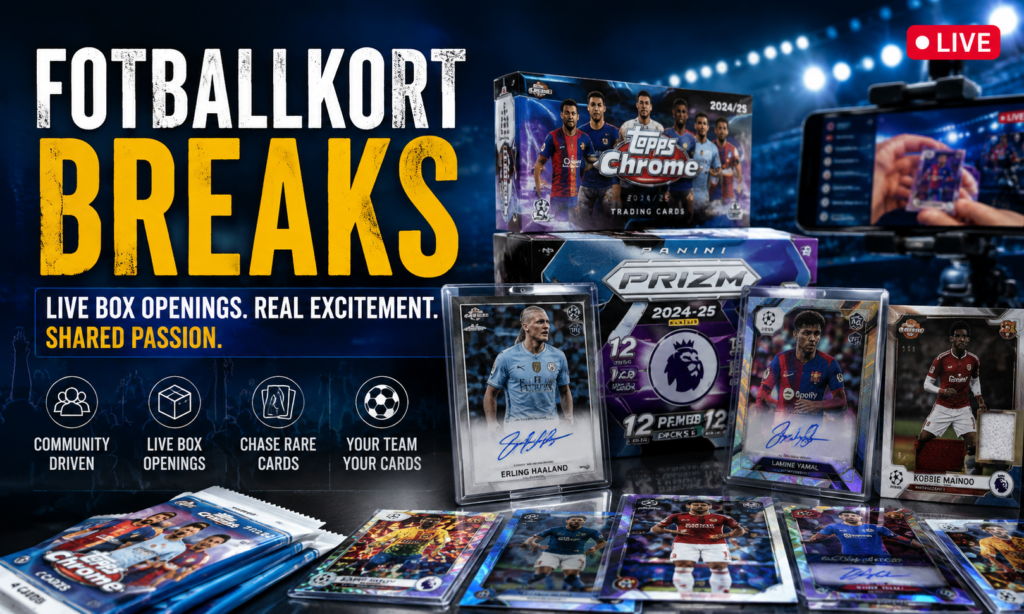

Football-card collecting is no longer limited to packets opened quietly at home. Across Norway and other parts of Europe, a growing break culture is bringing collectors together through livestreams, team-based purchases and shared box openings. Businesses and independent breakers now offer dedicated breaks featuring products from major manufacturers, reflecting how technology is reshaping a hobby built on nostalgia, rarity and chance.
What Are Fotballkort Breaks?
Fotballkort Breaks, A “break” is a format in which a sealed box or group of football-card products is opened live while participants receive cards according to a predetermined system.
Rather than buying an entire hobby box, a collector purchases a spot. Depending on the break, that spot can represent a particular football club, a randomly assigned team, a player or another category.
Several common formats have emerged: Fotballkort Breaks
- Pick Your Team (PYT): Participants select a club before the break.
- Random Team: A team is assigned to the participant through a randomisation process.
- Player Break: Participants purchase a spot connected to a particular player.
- Pack or Box Break: Cards are opened live and distributed according to the rules of the specific event.
The attraction is relatively straightforward. Premium hobby boxes can be expensive, while an individual break spot can provide access to the same product for a smaller upfront payment.
However, participants do not receive the entire box. The cards are distributed according to the break rules.
That distinction is central to understanding the format’s growing popularity.
From Sticker Albums to Premium Trading Cards
Football collecting has a long history.
For generations, children and adults collected stickers featuring national teams, clubs and famous players. Completing an album offered both entertainment and a snapshot of a particular football era.
Modern trading cards have expanded that concept considerably.
Today’s football-card products can contain:
- Base cards
- Rookie cards
- Refractors and parallels
- Numbered cards
- Autographs
- Memorabilia cards
- Short-print cards
- One-of-one cards
This difference matters for collectors interested in scarcity.
A standard card may be produced in relatively large quantities, while a numbered parallel could be limited to 99, 25 or even a single copy.
This has created a collecting environment in which a player’s identity is only one part of a card’s appeal. The set, design, serial number, condition and rarity can all influence collector interest.
Why Breaks Have Become a Digital Experience
Fotballkort Breaks, The biggest change may not be the cards themselves but the way they are sold and opened.
Traditional collecting was largely private. Someone purchased a packet from a shop, opened it, and perhaps traded unwanted cards with friends or classmates.
Breaks turn that moment into a public event.
Many breakers use livestreams to open products while participants watch in real time. Viewers can communicate through chats, react to pulls and discuss cards as they appear.
This creates several layers of engagement.
The Opening Becomes Entertainment
A sealed box contains uncertainty. Nobody knows exactly which rare cards will appear.
When the box is opened live, every pack becomes part of a shared experience. A rare autograph, numbered parallel or valuable rookie card can become the central moment of a stream.
For some collectors, that entertainment value is almost as important as the physical cards themselves.
Collectors Can Specialise
A collector focused on one club may not want hundreds of cards from unrelated teams.
Fotballkort Breaks, Break formats can help collectors focus on specific clubs or players.
For example, a participant might purchase a spot tied to a favourite football team and receive cards from that team from the box being opened.
This approach can make collecting more targeted.
The Community Becomes Part of the Hobby
Breaks have also created online communities.
Collectors can discuss products, compare pulls and share information about cards while an opening is taking place.
For newcomers, this can provide an introduction to modern football-card collecting that is very different from simply buying individual packs in a shop.
The Economics Behind the Break
At its simplest, a break divides the cost of a sealed product among multiple participants.
Imagine a hypothetical hobby box costing NOK 4,500. Instead of one collector paying the entire amount, a breaker may divide the opportunity into multiple team or player spots.
The exact economics depend on the product and the break structure, but the basic principle remains the same: the cost of opening the premium product is distributed across participants.
This can make expensive products accessible to collectors who would otherwise be unwilling or unable to purchase an entire box.
However, a lower entry price does not eliminate uncertainty.
Participants still take part in a randomised opening, and the cards they receive depend on the product’s contents.
The Risk of Receiving Nothing Significant
One of the most important aspects of breaks is that participants may not receive a major card.
Depending on the product and break format, a selected team may appear only a few times—or not at all.
This outcome is sometimes described within the hobby as getting “skunked.”
For example, if a collector purchases a spot for a particular club and that club has no cards in the boxes being opened, the participant may receive little or nothing of significant monetary value.
This is an important distinction between a break and purchasing a specific card.
A break does not guarantee a particular collectable.
Instead, it is participation in an opening with uncertain contents.
Understanding that difference matters, especially for people entering the hobby for the first time.
A Comparison With Traditional Collecting
The difference between conventional collecting and breaks can be summarised simply:
Traditional Purchase Football Card Break
Fotballkort Breaks, Buyer purchases a sealed product Participant purchases a break spot
Buyer opens the product personally Breaker opens the product
Buyer keeps all cards Cards are allocated according to rules
Higher upfront cost for premium boxes Smaller individual entry cost
Entire box belongs to one collector Contents are divided among participants
Neither approach changes the fundamental appeal of collecting.
The difference lies primarily in how the product is purchased and experienced.
The Role of Major Card Manufacturers
The expansion of the break market is closely connected to the growing range of premium football-card products.
Topps and Panini remain among the best-known names in the industry, producing cards connected with clubs, national teams and major competitions.
Modern releases can include multiple rarity levels, creating additional opportunities for breakers and collectors.
Premium products are particularly suited to breaks because the boxes can contain expensive autographs, rare parallels and memorabilia cards.
For collectors, the possibility of finding one of these cards is a major part of the appeal.
Major football tournaments can also create new collecting cycles.
Fotballkort Breaks, The 2026 FIFA World Cup, for example, represents an important event for the football-card market. Major tournaments introduce new products, players receive more international attention, and collectors often seek cards tied to memorable performances.
A New Generation of Collectors
The modern football-card audience is broader than the traditional sticker collector.
Some participants are motivated by nostalgia. Others collect a particular club, player or national team.
Some focus heavily on card condition and grading, while others prefer numbered cards, autographs or memorabilia.
Collecting is also increasingly crossing over with digital entertainment.
A collector can watch a live break, interact with the host, see a card pulled on camera and eventually receive the physical card.
That combination makes the hobby resemble both traditional collecting and livestream entertainment.
The Investment Question
Football cards are sometimes discussed as investments, but the market doesn’t guarantee returns.
Card values can change because of several factors:
- Player performance
- Transfers between clubs
- Tournament performances
- Card scarcity
- Condition and grading
- Collector demand
- Popularity of the particular set
- Wider conditions in the collectables market
A rare card featuring a famous player may attract substantial interest, but rarity alone does not guarantee that its value will increase.
The same applies to young players.
A promising player can become a global star, remain relatively unknown or experience an unexpected change in career circumstances.
As a result, many experienced collectors distinguish between buying cards because they personally enjoy them and purchasing cards primarily because they expect future price increases.
Transparency Is Becoming More Important
As the break industry matures, transparency matters more.
Participants need to understand exactly what they are purchasing and how the break will be conducted.
Important questions include:
- How are teams or players assigned?
- Which products will be opened?
- What happens if a selected team receives no cards?
- Are all cards shipped to participants?
- How are valuable cards handled?
- What happens to duplicate or unwanted cards?
- What are the shipping arrangements?
Clear rules can reduce misunderstandings and make the experience easier for newcomers.
Terms can vary significantly between breakers and products, so participants should understand the rules before buying a spot.
What Could Happen Next?
The short-term future of fotballkort breaks will likely remain closely tied to new product releases and major football events.
International tournaments provide natural moments for collectors to become interested in new cards, while annual club competitions continue to generate new products.
The growth of livestreaming may also push breakers toward increasingly professional production.
Better cameras, automated randomisation systems, real-time sales platforms and improved shipping systems could make breaks more accessible to international audiences.
At the same time, the hobby will continue to face questions about cost, chance and resale values.
The industry’s central challenge is maintaining the entertainment and community aspects of breaks while ensuring participants clearly understand the financial uncertainty involved.
Conclusion
Fotballkort breaks represent more than a new way to open football cards. They demonstrate how a traditional collecting hobby is adapting to livestreaming, online communities and increasingly sophisticated trading-card products.
The fundamental attraction remains familiar: football, rarity and the excitement of discovering something unexpected.
What has changed is the setting.
Instead of opening a pack alone, collectors can now share the experience with dozens or even hundreds of enthusiasts watching the same box open in real time.
As football-card products become increasingly premium and digital communities continue to grow, breaks are likely to remain an important part of the modern collecting landscape.
The longer-term question is how the hobby will balance entertainment, community, collecting value and financial uncertainty as the football-card market continues to evolve.