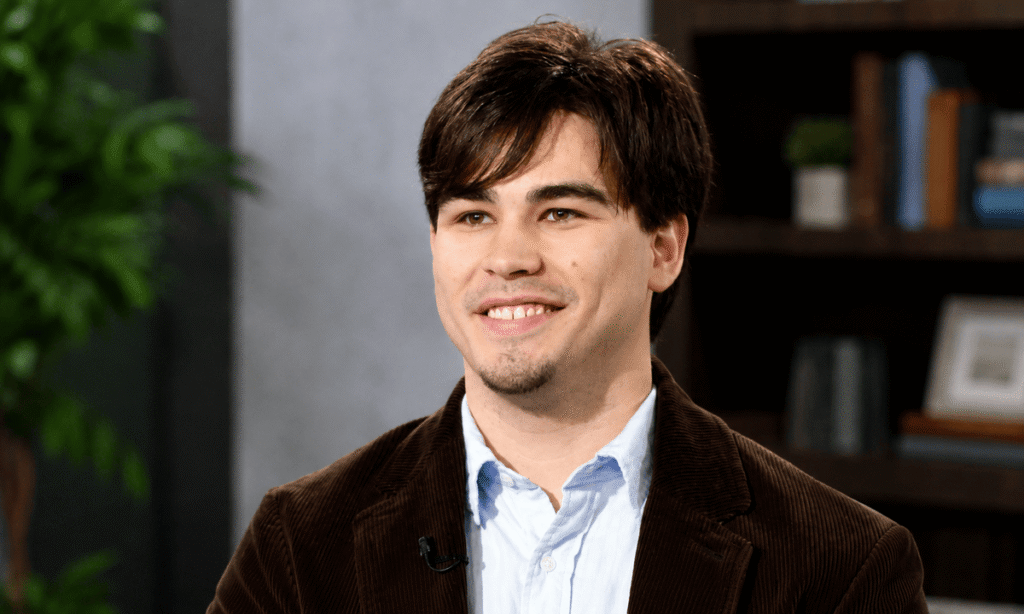

Few childhood stories have attracted as much attention as that of Michael K Kearney, the American prodigy who became a college graduate at just 10 years old. His achievements earned him a spot in the Guinness World Records and made him a media sensation. But the more interesting story is what came afterward: advanced degrees, television appearances, major game-show winnings, and an adult life that moved beyond the label of “child genius.”
The making of an extraordinary academic record
Michael K. Kearney, whose birth name is Michael Kevin Kearney, was born in Honolulu, Hawaii, in 1984. From an unusually early age, his intellectual development appeared far ahead of conventional educational milestones.
Historical accounts describe Kearney as developing language and reading skills remarkably early. His parents eventually chose an accelerated, largely individualized educational path rather than keeping him on the standard progression of school grades.
That decision became the foundation of a remarkable academic career.
By the age of 6, Kearney had completed what was described as a high-school-level education. He then began college-level study while still a child.
In June 1994, at 10 years and 4 months old, he received a bachelor’s degree in anthropology from the University of South Alabama. Guinness World Records identifies him as the youngest graduate at that time.
Michael K Kearney’s achievement was not simply a media claim. Contemporary reporting documented his graduation with honors and a 3.6 grade-point average on a four-point scale.
The accomplishment also placed Kearney in a historical conversation about how educational systems should respond to children whose abilities develop dramatically faster than their age group.
Education outside the traditional timetable
Michael K Kearney’s childhood education was unusual not only because of its speed but because of the environment surrounding it.
His parents played an important role in designing his education. Contemporary reporting described a family willing to move away from conventional schooling when it no longer appeared capable of providing the intellectual stimulation he needed.
That approach generated both admiration and debate.
Why acceleration became necessary
For most children, education follows a relatively fixed sequence: elementary school, middle school, high school and then university.
Michael K Kearney’s development challenged that structure.
When a child can understand material years ahead of classmates, keeping that student in a conventional classroom can create a different kind of problem. The issue is no longer simply whether the child can learn, but whether the educational environment can keep pace.
His father, Kevin Kearney, argued that advanced placement was necessary because Michael needed intellectual stimulation. ABC News later revisited the family story and reported that his parents believed moving him through education quickly was preferable to leaving him academically unchallenged.
That philosophy remains relevant today as schools and universities continue to debate acceleration, gifted education and individualized learning.
The public fascination with a child genius
Kearney’s achievements quickly moved beyond classrooms.
By the mid-1990s, newspapers and television programs were treating him as a national curiosity. A 1995 Los Angeles Times profile described him as the world’s youngest college graduate and examined the very different reactions his achievements generated in the United States and Japan.
The attention brought opportunities, but it also created an unusual challenge: Kearney was simultaneously a child, a student and a public figure.
Michael K Kearney expressed an early interest in becoming a television game-show host. That ambition was not entirely surprising. Trivia and competition programs provided a natural outlet for someone whose intellectual abilities had already made him famous.
Kearney even auditioned for television and appeared in the 1995 made-for-TV movie Family Reunion: A Relative Nightmare. His entertainment interests would later become an important part of his adult story.
Advanced degrees and a second academic chapter
Graduating from college at 10 did not end Kearney’s education.
Instead, he continued into advanced study.
Guinness World Records records that Kearney entered Middle Tennessee State University and later received a master’s degree in biochemistry in August 1998, when he was 14 years and 8 months old. The record organization lists him as graduating with an A-minus grade-point average.
Michael K Kearney’s academic journey subsequently expanded into computer science.
According to biographical records, he earned another master’s degree from Vanderbilt University at 18.
The combination was striking: anthropology, biochemistry and computer science represented very different academic disciplines.
Rather than following a single narrowly defined specialty, Kearney’s education reflected a broad intellectual curiosity.
Beyond the numbers
It is tempting to measure Kearney’s life entirely through ages and degrees.
That approach, however, misses an important part of the story.
A record such as “youngest college graduate” is easy to understand because it fits into a single number. Intellectual development itself is far more complicated.
Researchers and educators have long pointed out that gifted children can require different educational approaches, but intellectual ability does not automatically determine social development, emotional maturity, or future career direction.
Michael K Kearney’s later life illustrates that distinction.
When the prodigy became a television competitor
By his early twenties, Michael K Kearney’s relationship with education had changed.
Rather than remaining permanently defined by academic achievement, he began exploring entertainment and competitive television.
In 2006, he won AOL’s Gold Rush, an interactive competition created by television producer Mark Burnett. CBS News reported that Kearney won the $1 million grand prize after advancing through the competition.
The victory was significant for another reason.
It demonstrated that his unusual abilities were not confined to classrooms or academic examinations. He could also perform under the pressure of public competition.
At the time, CBS described Kearney as a 22-year-old former child prodigy who had already completed multiple degrees.
The transition from academic prodigy to game-show winner gave the public a different way to understand him.
Michael K Kearney was no longer simply the child who had achieved something extraordinary. He was becoming an adult with his own interests and ambitions.
Another appearance on Who Wants to Be a Millionaire?
Kearney’s television career continued.
In 2008, he appeared on the syndicated version of Who Wants to Be a Millionaire?. Records from Middle Tennessee State University state that he won $25,000 during the appearance.
The result was modest compared with his $1 million Gold Rush victory, but symbolically it was important.
Michael K Kearney had returned to the type of environment he had wanted to enter as a child: the world of televised trivia and entertainment.
His early ambition had not disappeared. It had simply taken a different form.
What happens after childhood genius?
Perhaps the most enduring question surrounding Kearney is not how he became a prodigy, but what happened after the childhood headlines faded.
That question has attracted researchers and journalists because child prodigies often become difficult to understand once they reach adulthood.
A 2005 ABC News report revisited Kearney at 21 and asked what becomes of child geniuses after childhood. The report highlighted the broader debate over whether exceptionally gifted children should be accelerated through school or given more conventional childhood experiences.
Kearney’s case provides no simple answer.
Michael K Kearney did not disappear after his record-setting graduation. Nor did he remain permanently within academia.
Instead, his path moved through several worlds:
- Early accelerated education
- Anthropology and university study
- Graduate-level science
- Computer science
- Television appearances
- Competitive game shows
- Improvisational entertainment
That variety is arguably one of the most revealing parts of his story.
A changing understanding of gifted education
Kearney’s childhood unfolded during an era when gifted education was often discussed through extraordinary test scores, accelerated grades and academic records.
The modern conversation is broader.
Experts increasingly distinguish between intellectual ability and the range of developmental needs a child may have. Academic acceleration can be highly effective for some students, but it must be accompanied by appropriate social and emotional support.
Kearney’s experience also shows why comparisons between gifted children can be misleading.
Another child might possess extraordinary mathematical ability but prefer a conventional school environment. Someone else might excel academically while developing more slowly in social settings.
No universal formula exists for raising or educating a prodigy.
Kearney’s parents made a particular set of choices based on the child they believed they knew. The result was extraordinary, but it should not automatically be treated as a blueprint for every gifted student.
Why Michael K. Kearney still matters
More than three decades after his academic achievements first attracted attention, Kearney remains relevant because his story sits at the intersection of several continuing debates.
1. Education should not always be one-size-fits-all
His experience demonstrates what can happen when a student moves far beyond the expected academic pace.
2. Achievement does not end childhood development
A remarkable academic record cannot erase the fact that a young person is still developing socially and emotionally.
3. Early success does not dictate an entire career
Kearney’s later movement into entertainment shows that extraordinary academic ability does not necessarily lead to a conventional academic profession.
4. Public attention can shape a young person’s identity
Being labeled a “genius” can create expectations that continue long after childhood.
That may be one of the least visible consequences of prodigy status. Once a person becomes famous for being exceptional, ordinary experimentation and career changes can appear surprising even though they are normal parts of adult life.
The broader legacy
Kearney’s record has also become part of a larger history of unusually young university graduates.
In recent years, other young students have attracted attention for completing college at exceptionally early ages. Yet contemporary reporting still identifies Kearney’s 10-year-old graduation as a landmark achievement. The Los Angeles Times referenced him again in 2025 while discussing another unusually young college graduate.
That continuing reference suggests that his accomplishment has survived well beyond its original news cycle.
But his most meaningful legacy may not be the number attached to his age.
It may be the questions his life still raises.
What should education look like when a student’s ability does not fit the standard timetable? How much acceleration is beneficial? Where is the balance between nurturing extraordinary talent and protecting a child’s broader development?
And perhaps most importantly, what should society expect from someone who achieves something extraordinary before adulthood?
Looking ahead
Michael K. Kearney’s story began with a record that seemed to promise a straightforward future: the world’s youngest college graduate would presumably become an equally extraordinary academic or scientific figure.
Life proved less predictable.
His education continued through multiple disciplines, his interests moved toward television, and his public identity evolved from child prodigy to adult entertainer and competitor. The trajectory demonstrates that exceptional beginnings do not necessarily produce conventional endings.
The fascination with Kearney therefore lies not only in what he accomplished at 10, but in what happened after he set the record.
His experience remains a useful historical case study in gifted education, childhood achievement and the complicated transition from extraordinary youth to ordinary adulthood. The enduring question is not whether a child can move faster than the system, but whether the system can give that child enough room to discover who they become once the race is over.