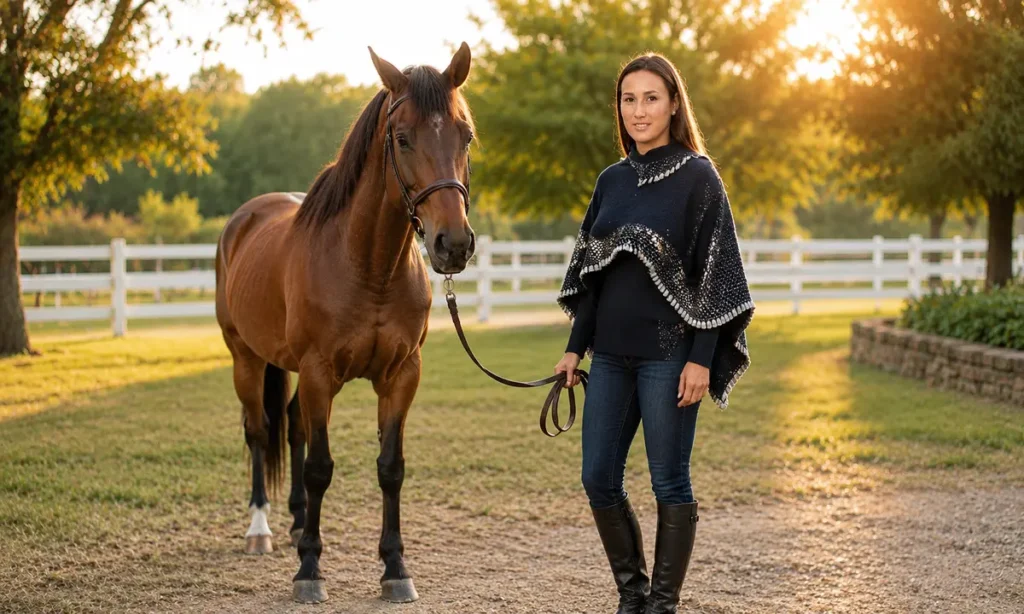

For many people, the name Kansas Carradine first brings to mind Hollywood. Born into the celebrated Carradine acting dynasty, she is the daughter of Kung Fu star David Carradine and granddaughter of character actor John Carradine. But her own career has followed a markedly different path. Today, Kansas Carradine is better known for her decades in the equestrian world, where riding, performance, horse training and education have become central to her professional identity.
A Carradine by Name, an Equestrian by Choice
Kansas Anne Carradine was born on April 19, 1978, in Los Angeles. Her parents were David Carradine and Linda Gilbert, whose marriage lasted from 1977 to 1983. She grew up within one of America’s most recognizable acting families, a dynasty that included her father, uncles Keith and Robert Carradine, and grandfather John Carradine.
Yet the defining influence on Kansas Carradine’s adult career was not simply Hollywood.
Horses became a constant presence from childhood. Kansas Carradine developed an interest in riding at a young age and eventually entered the world of professional trick riding. By her early teens, she was already developing the specialized skills that would later become central to her career.
That early experience established the foundation for a professional life that would take her far beyond the expectations attached to her surname.
Growing Up Around Performance
The Carradine family had already established a reputation for unconventional careers in entertainment.
David Carradine became internationally recognized as the star of Kung Fu, while later films such as Kill Bill introduced his work to another generation. His career also included directing, music, and stage work.
Kansas entered the entertainment business herself. She appeared in several film and television productions, giving her some direct experience with the industry in which her father and relatives had spent much of their lives.
Her screen career, however, remained relatively limited compared with the scale of her father’s Hollywood legacy.
That distinction is important. Rather than building her identity primarily as an actor, Carradine increasingly developed expertise in an entirely different form of performance: working with horses.
From Trick Rider to International Performer
Carradine’s equestrian career expanded significantly after her early years as a trick rider.
She became associated with professional equestrian productions and performed in demanding disciplines, including trick riding, trick roping, Roman riding, and liberty work.
Roman riding requires exceptional balance and coordination because the rider performs while standing on multiple horses moving together. It combines athletic ability, timing and extensive training, but it also depends heavily on understanding the behavior of the animals involved.
For Carradine, the discipline became more than a stage skill.
It became a professional language through which she could connect performance, horsemanship and education.
The Evolution Beyond Hollywood
The most interesting part of Carradine’s story is arguably what happened after she established herself as a professional equestrian performer.
Rather than remaining focused exclusively on spectacle, she increasingly moved toward teaching, horse training, and personal development.
Her professional work has included equine-guided education and programs focused on the relationship between people and horses. The emphasis is on using interactions with horses to explore communication, emotional awareness, confidence and personal development.
This represents a broader shift occurring in parts of the modern equestrian world.
From Entertainment to Horsemanship
Traditional horse shows often emphasize competition, technical performance and spectacle. Carradine’s more recent work places greater emphasis on the relationship between horse and human.
Her approach incorporates elements of horsemanship, emotional awareness and personal development.
Supporters of such approaches argue that horses can provide immediate feedback to human behavior. Because horses respond to posture, movement, tension and other cues, working with them can encourage participants to become more aware of their own reactions.
Carradine’s work therefore sits at the intersection of several fields:
- Equestrian education
- Horse training and welfare
- Performance and stunt riding
- Emotional self-regulation
- Personal development
- Community and charitable work
That combination helps explain why her career has developed beyond the traditional boundaries of entertainment.
The Gaucho Derby and a New Chapter
One of the clearest examples of Carradine’s continuing commitment to demanding equestrian experiences came in 2024, when she participated in the Gaucho Derby in Patagonia.
The event is a long-distance endurance challenge across Argentina’s Patagonia region. Carradine’s participation represented another significant stage in an equestrian career that had already included professional performance and international travel.
Endurance riding presents a very different challenge from theatrical performance.
Instead of performing a carefully choreographed routine before an audience, riders must manage distance, terrain, navigation, physical stamina, and their horses’ condition over an extended period.
For an experienced professional such as Carradine, the experience also illustrates how dramatically her career has evolved.
She began by entertaining audiences through equestrian stunts. Decades later, she was testing herself through long-distance endurance riding while continuing to teach and advocate for responsible relationships between humans and horses.
Animal Welfare and the Changing Equestrian Conversation
Carradine’s professional profile also reflects a growing conversation within the horse industry about animal welfare.
Her work has included horse rehabilitation, adoption efforts and programs designed to strengthen the relationship between people and animals.
The emphasis on welfare matters because equestrian entertainment has increasingly come under scrutiny over how animals are trained and presented.
Modern audiences are more likely to ask not only whether a performance is impressive, but also how the horses are treated to produce it.
Carradine’s public work attempts to position horsemanship around trust, communication and compassion rather than performance alone.
That does not eliminate the inherent demands of equestrian sport. Horses remain powerful animals, and riding and training carry physical risks for both humans and animals. But the emphasis on welfare signals how expectations within the industry continue to evolve.
A Family Legacy Without Being Defined by It
Kansas Carradine’s relationship with her family name remains an unavoidable part of her biography.
Her father was one of the most recognizable television and film actors of his generation. Her grandfather, John Carradine, had a long career in Hollywood, and her extended family includes several actors and performers.
Yet the trajectory of Kansas’s career demonstrates that a famous surname does not necessarily dictate professional identity.
Her acting credits are part of her history, but her decades of work with horses have become the more distinctive feature of her public career.
In that sense, her story offers an interesting contrast to the stories of other children of famous entertainers.
Rather than attempting to reproduce her father’s career, she developed a specialized field in which her family’s theatrical background and her own equestrian abilities could overlap without becoming dependent on Hollywood.
Teaching, Wellness and Community Work
Carradine’s more recent work also extends beyond professional riding.
Her educational programs have focused on emotional self-regulation, confidence and the relationship between people and animals. She has also been associated with initiatives involving therapeutic riding and community programs.
The broader appeal of equine-guided education comes from the horse’s role as an immediate, nonverbal participant.
Unlike a conventional classroom environment, working with an animal can make communication problems visible through behavior and interaction. Practitioners believe that this can create useful opportunities for people to examine their own responses.
At the same time, experts in animal-assisted interventions generally emphasize that outcomes depend on program design, participant circumstances, and qualified professionals. The strongest claims should therefore be distinguished from personal experiences or broad wellness messaging.
That distinction is particularly relevant as equine-based programs become more visible outside traditional horse communities.
What Comes Next for Kansas Carradine?
Carradine’s career now appears less centered on conventional entertainment and more focused on education, horsemanship and human-animal connection.
In the short term, that could mean continued workshops, speaking engagements, riding projects and equine-guided education. Her experience in professional performance gives her an unusual foundation for teaching: she understands both the demands of high-level riding and the importance of communication between horse and rider.
Over the long term, her career could become part of a larger shift in how equestrian professionals present their work.
The horse industry is increasingly balancing tradition with concerns about welfare, sustainability, accessibility, and emotional well-being. Professionals who can bridge those areas may find opportunities beyond the conventional competitive arena.
Carradine’s background is particularly well-suited to that transition because it spans several generations in entertainment, decades of equestrian experience, and a growing interest in education and wellness.
The Larger Significance of Her Story
Kansas Carradine’s story is ultimately less about being David Carradine’s daughter than about how she made of the circumstances into which she was born.
She inherited access to a famous Hollywood name, but her professional identity developed elsewhere. From trick riding as a child to international equestrian performance, horse training, endurance riding and education, her career has been shaped by a long relationship with animals and performance.
Her story also illustrates how careers can evolve. The skills that once served entertainment—balance, discipline, timing, communication and confidence—can later become tools for teaching and mentorship.
Today, Kansas Carradine occupies a distinctive place at the intersection of Hollywood heritage and the equestrian world. Her public profile may always carry the Carradine surname, but the work that increasingly defines her is her own.
The question looking ahead is not whether she will return to the Hollywood path associated with her family. It is a question of whether the next stage of her career will further demonstrate how horsemanship can move beyond performance and competition toward education, welfare, and human connection.