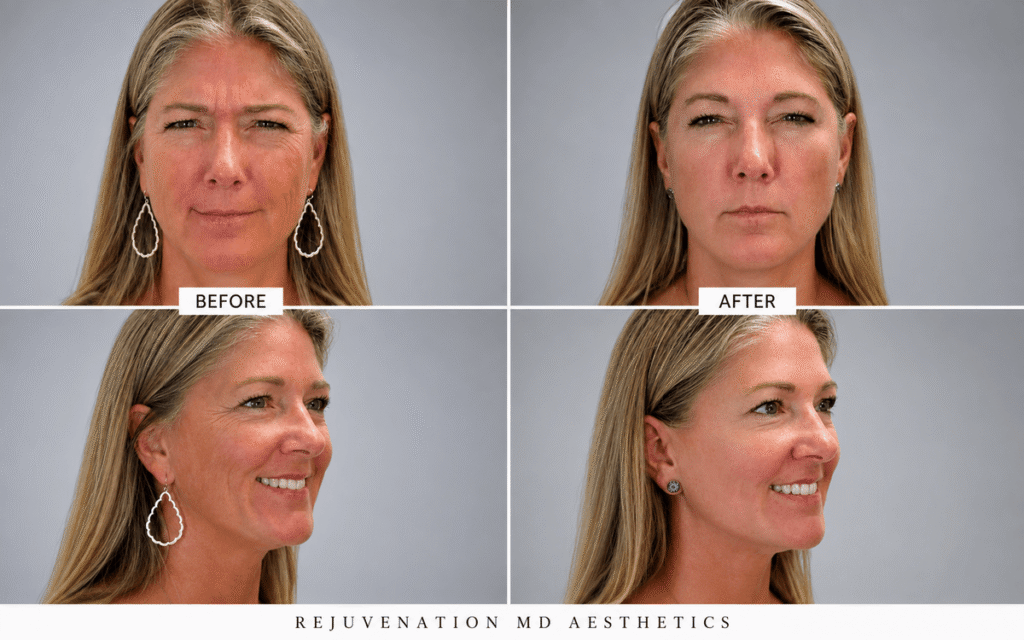

The vertical creases that run from the corners of the mouth toward the chin are among the most recognizable signs of facial ageing. Known as marionette lines, they can make the lower face appear heavier or the mouth seem downturned. Botox has emerged as one possible treatment, but unlike its established use in the upper face, treating marionette lines requires a much more precise understanding of facial anatomy.
Why Marionette Lines Have Become a Cosmetic Focus
Marionette lines are not simply wrinkles in the conventional sense. They develop through a combination of skin ageing, changes in facial volume, altered soft-tissue support and muscle activity.
Research on the ageing of the central lower face identifies several contributing factors, including loss of fat and bone volume, changes around the mandible, reduced skin elasticity, and the development of fixed and dynamic wrinkles.
Marionette lines botox,hat distinction matters because Botox works primarily by temporarily reducing muscle activity. It does not replace lost volume or restore sagging skin.
For some patients, the muscle component of a marionette lines botox may therefore be an important treatment target. For others, particularly those with pronounced folds caused by structural volume loss, Botox alone may have limited effect.
This is one reason aesthetic specialists increasingly describe lower-face rejuvenation as a multimodal problem rather than a single-injection solution.
What Exactly Are Marionette Lines?
The term refers to folds extending downward from the corners of the mouth toward the chin. Their name comes from the hinged mouths of traditional marionette puppets.
They can appear as:
- Fine lines visible mainly during facial movement
- Deeper folds that remain visible at rest
- Downturned corners of the mouth
- A combination of wrinkles, volume loss and early jowling
The underlying anatomy is complex. Muscles around the mouth constantly pull in different directions, while the skin and soft tissues change with age.
One muscle of particular interest is the depressor anguli oris, or DAO. Its contraction can pull the corners of the mouth downward. By reducing excessive activity in this muscle, botulinum toxin may lessen the downward pull and soften the appearance of certain marionette-related changes.
But that does not mean the DAO causes every marionette line.
A 2025 anatomical review emphasized that marionette lines are multifactorial and that treatment may involve both structural volume correction and neurotoxin therapy, depending on individual anatomy.
From a Medical Treatment to a Cosmetic Mainstay
Botulinum toxin has a much longer medical history than its association with cosmetic injections might suggest.
The FDA originally approved botulinum toxin type A for medical indications, including blepharospasm and strabismus. In 2002, the agency approved Botox Cosmetic for temporary improvement of moderate-to-severe glabellar lines—the vertical “frown lines” between the eyebrows.
That approval helped establish the modern cosmetic neurotoxin industry.
Over the following years, clinicians began applying the same basic pharmacological principle to other facial muscles. The upper face remained the best-studied area, while the lower face presented a more difficult challenge.
An early review of lower-face applications noted that the anatomy varies considerably between patients and even between the two sides of the same person’s face. Researchers cautioned that misplaced treatment in the lower face could be less forgiving than treatment in the upper face.
That observation remains central to the debate around Botox for marionette lines.
How Botox May Help
Botulinum toxin works by temporarily interfering with nerve signals that cause targeted muscles to contract.
For marionette-related treatment, the objective is generally not to “fill” the crease. Instead, a clinician may attempt to reduce the muscular force contributing to downward movement around the mouth.
The potential result can include:
- Less downward pull at the mouth corners.
- A softer appearance of dynamic lines.
- A subtle improvement in the transition between the mouth and chin.
- A more balanced appearance when the patient smiles or relaxes the face.
The distinction between dynamic movement and static structure is particularly important.
If a crease appears primarily because a muscle contracts, weakening that muscle can make a meaningful difference. If the crease is deeply etched because of long-term skin folding and tissue loss, the effect of Botox may be considerably more modest.
What Does the Evidence Show?
The evidence is encouraging but less extensive than for traditional upper-face Botox.
A 2021 systematic review examined cosmetic use of abobotulinumtoxinA—a botulinum toxin type A product—in the middle and lower face and neck. Of the 560 unique articles initially identified, only 10 met the review’s inclusion criteria. Five of those studies involved marionette lines. The authors reported positive findings overall but also identified the lower face as an area where further research was needed.
That evidence gap is significant.
For comparison, upper-face Botox has been evaluated in large randomized controlled trials. A 2023 meta-analysis of 14 randomized trials included 8,369 participants and found strong evidence for reducing glabellar, forehead and crow’s-feet lines.
The contrast illustrates why a treatment that is well established for forehead wrinkles should not automatically be assumed to have the same evidence base for marionette lines.
A Small but Revealing Clinical Study
One study examining lower-face and neck rejuvenation treated 30 patients with abobotulinumtoxinA. The researchers found statistically significant improvements in platysmal bands, while changes in marionette lines and other lower-face features showed trends toward improvement that did not reach statistical significance. Nevertheless, 93.3% of investigators and patients rated the overall result as improved, and 96.6% of patients reported satisfaction.
Such findings demonstrate both sides of the issue: patients can perceive an aesthetic benefit, but improvements in individual components such as marionette lines may be difficult to measure consistently.
Why the Lower Face Requires Greater Precision
The mouth is a highly functional part of the face. People use it to speak, smile, eat, drink and express emotion.
That creates a narrow margin for error.
Too much weakening of the wrong muscle—or toxin spreading into nearby muscles—can potentially affect the symmetry or movement of the mouth.
A comprehensive review published in 2024 concluded that botulinum toxin has expanded into numerous lower-face applications but also emphasized unresolved questions concerning injection sites, dosing and technique.
Earlier safety research similarly found that lower-face complications could include temporary lip asymmetry and muscular imbalance. In one systematic review covering 8,787 subjects across aesthetic botulinum toxin studies, lower-face adverse events involving lip asymmetry or imbalance occurred in 6.9% of reported cases and resolved spontaneously in the studies reviewed.
That does not mean complications are inevitable. It does mean that lower-face injections demand anatomical expertise.
Botox Is Not the Same as a Filler
The distinction between Botox and dermal filler is sometimes blurred in consumer discussions.
They address different problems.
TreatmentPrimary purposePotential role in marionette lines
Botulinum toxin Temporarily reduces targeted muscle activity May reduce a muscular downward pull
Dermal filler Adds volume and structural support May soften deeper folds caused partly by volume loss
Energy-based treatments Target skin quality and tissue remodelling May improve texture or laxity in selected patients
Surgery Repositions or removes tissue Considered for more substantial structural ageing
For some patients, the most appropriate strategy may involve more than one approach.
Recent anatomical literature has specifically described combining neurotoxin treatment with filler when both muscular activity and volume loss contribute to the appearance of marionette lines botox.
The Regulatory Question
marionette lines botox,Another important distinction is between what a drug is approved to treat and what physicians may use it for in clinical practice.
In the United States, current Botox Cosmetic labelling includes indications such as forehead lines, glabellar lines, lateral canthal lines and platysma bands. Marionette lines are not listed as a specific FDA-approved cosmetic indication in the current labelling.
Consequently, treatment of marionette lines with Botox may constitute an off-label use in the United States.
Off-label prescribing is neither inherently experimental nor prohibited; physicians may use approved medicines for medical purposes beyond their labelled indications when they deem it appropriate. But the distinction matters because patients should not confuse an FDA-approved indication for Botox generally with FDA approval specifically for marionette lines botox.
Regulatory rules also differ between countries.
What Patients and Clinicians Are Weighing
Marionette lines botox,For supporters of the treatment, the appeal is straightforward: botulinum toxin can provide a temporary, minimally invasive way to address a muscular component of lower-face ageing.
Critics and cautious clinicians point to the weaker evidence base and the possibility that Botox is being asked to solve a structural problem it cannot fully correct.
Both perspectives contain an important truth.
A person with relatively mild, movement-related marionette changes may respond differently from someone with pronounced tissue descent and volume loss.
Experts therefore emphasise assessment rather than a standardised injection formula.
Factors that can influence the decision include:
- The depth of the folds
- Muscle activity around the mouth
- Degree of skin laxity
- Facial symmetry
- Existing jowling
- Soft-tissue and bone-volume changes
- Previous cosmetic procedures
- The patient’s expectations
Looking Ahead
Marionette lines botox,he direction of cosmetic medicine suggests that treatment of the lower face will continue to become more individualized.
Researchers are already studying techniques that combine anatomical assessment with targeted neurotoxin and filler approaches. At the same time, reviews continue to identify a need for better prospective studies to establish standardized treatment methods and clarify which patients benefit most.
The future may therefore be less about finding a single “best” injection for marionette lines and more about determining which biological mechanism underlies an individual’s particular appearance.
That could eventually lead to clearer treatment algorithms: muscle-driven lines treated differently from volume-driven folds, and both treated differently from primarily skin-related ageing.
Conclusion
Marionette lines botox sits at an interesting intersection between established cosmetic medicine and an area where clinical evidence is still developing.
The science behind botulinum toxin is well established, but its application to the lower face is more technically demanding than its traditional use around the forehead and eyes. Marionette lines are not a single problem with a single cause, and that makes simple treatment promises difficult to justify.
For now, the strongest evidence supports a measured approach: careful anatomical assessment, realistic expectations and recognition that neurotoxin may address only one part of the ageing process.
Marionette lines botox,As lower-face rejuvenation becomes increasingly sophisticated, the larger question may not be whether Botox can soften marionette lines, but how precisely clinicians can determine when muscle activity is the problem—and when the face is asking for an entirely different solution.